
"Toy Story 4" Review: A Welcomed Finale...Hopefully

The announcement of Toy Story 4 was a shock to the system. Toy Story 3 was the perfect bow for the franchise. Pixar definitely can teach other studios how to keep a franchise going past its seemingly end. While the latest film has all the warm fuzzies, jokes, love, and deep storytelling that we’ve enjoyed in the past, I respectively and lovingly hope this is it.
The film picks up where the last left off but a few years down the line. Bonnie (Madeleine McGraw) is on her way to kindergarten. She still has Woody (Tom Hanks), Buzz (Tim Allen), Jessie (Joan Cusack) and the rest of the gang. While she’s not old enough to stop playing with all of her toys, Bonnie certainly has her favorites, and Woody is not one of them. He gets left in the closet and collects dust bunnies while everyone else gets played with. Since Woody has always been the leader, this change is something he’s grappling with.
After her first day of school, Bonnie comes back with a new toy she created named Forky (Tony Hale). Understanding how much a toy means to the human he serves, Woody makes it his mission to keep Forky from throwing himself in the trash and getting himself lost. This includes making sure he stays safe on the family road trip in the RV, which of course is a task in itself.

What Pixar does better than most is explain life to us with child-like simplicity. They take us back to the basics time and time again. In this film, the big lesson is how we evolve in our relationships with loved ones. Woody has had his time with Andy and got a second chance with Bonnie, but what happens when our metaphorical Bonnie moves on? What do we do with the feeling of no longer being needed? How do you overcome your mentality of finding your self-worth in someone else or the opinion of others? There are all kinds of deep lessons that can be learned when you dig past the surface of what’s presented, and of course it’s laced with gags and humor.

The adventure the gang goes on is a fun and comical ride. There certainly was another story that could be told with Toy Story. The directors have stated that this is a fitting end for Woody and possibly the franchise but they thought it would be over after Toy Story 2. I hope they let this be the end because they have squeezed all the juice out of the lemon to create the delicious pitcher of lemonade that is the franchise. Perhaps Toy Story 3 left us thirsty for more, but Toy Story 4 is the confirmation that we’re good to go.
Rating: B

"The Post" Review: Truth is Timeless

What happens when you get one of the greatest directors of our time to work with two of the greatest actors of our time? Well, it may not be the best journalism thriller of our time, but the answer is The Post. It’s still a good time at the movies and a movie that speaks to our time!
Not long into the running time will you be able to draw the parallels between the need for the freedom of the press now and the same need during 1971 in which the movie is set. The film covers the Washington Posts’ fight to print the Pentagon Papers, documents containing highly classified information about the U.S. involvement in the Vietnam War. Meryl Streep is Katharine (Kay) Graham, the owner of the Post. She has to walk a thin line of being a woman in power, pleasing her board of directors in seeing papers sell, and trying to stay true to the paper’s journalistic integrity. Ben Bradlee (Tom Hanks) is the editor of the Washington Post. He’s old school and doesn’t care about the politics behind the scenes that Graham has to deal with.
When the New York Times gets the scoop on the Pentagon Papers, Bradlee is on a mission to get the story. An opening arises when Ben Bagdikian (Bob Odenkirk) chases down sources to get his hands on the Papers and the Times comes under fire from the government. The crux of the conflict in the film comes down to whether the Post should publish the truth by printing the classified documents and risk being destroyed. It’s the moral conflict that director Steven Spielberg is able to explore with his camera and cast of amazingly talented actors that makes this film so intriguing.

Both Graham and Bradlee come to see that the frequent social activities they’ve shared with government officials they call their friends has put them in a tough spot. Publishing the papers can bring sons of the United States home from a war that they’ve been losing for years, but it may put their friends in legal trouble. It’s the personal connection that we all have had to deal with in our lives that can create a moral dilemma out of something that should be simple. Of course, the right thing to do is to burn the establishment down and print the Papers, but it’s difficult when you know the faces of those who will be affected.
Spielberg uses plenty of one takes to draw us into the tension. He gives a master class in how to keep the camera rolling through a long scene without cutting away, but instead allowing the camera to focus on what’s important. He moves out of a closeup with one character, into a two-shot with another, and then to a wide with effortless ease. It’s also evident that Spielberg respects the process and importance of the printing press in the era. He takes moments to show letters being arranged for printing, and groups of people running to the paper to consume information that we take for granted receiving these days in an instant on our cell phones.
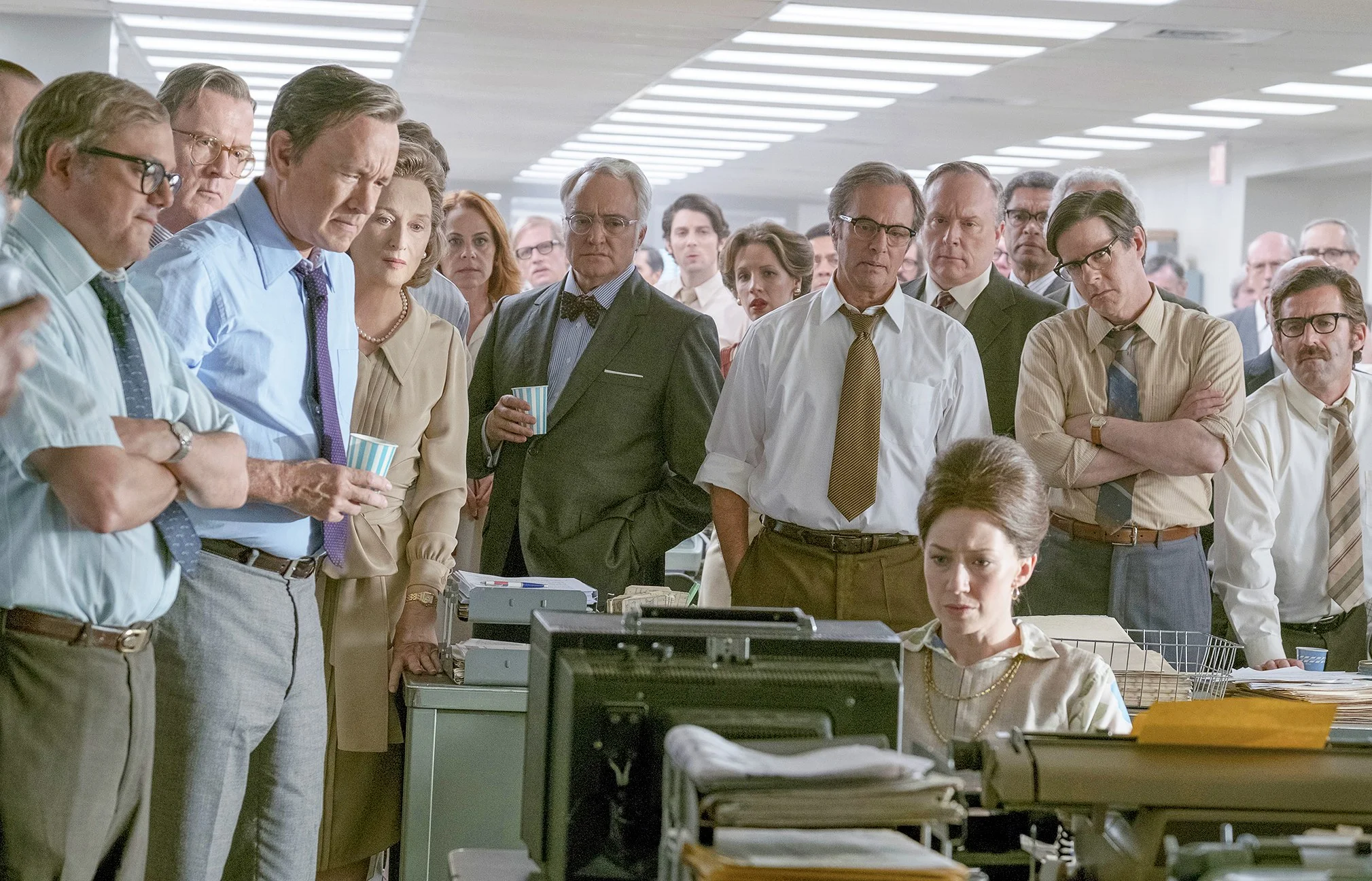
There’s no doubt that there is a beautiful dance between the camera and the actors’ performances. With lines being delivered by Hanks, Streep, Odenkirk, Bradley Whitford, Jesse Plemmons, (an underused but serving the storyline of woman’s roles in the 70‘s household) Sarah Paulson and more, the combination makes for an entertaining film.
While The Post may not stand with titans like All The President’s Men and Spotlight in regard to incredible journalism thrillers, it’s not too far behind. The public should know the truth about the government who is supposed to serve them, but The Post explores the grey area that makes it hard to be done at times. Nonetheless, it shows that the right side of history is always the one that tells the truth.
Rating: B+
"Bridge of Spies" Review
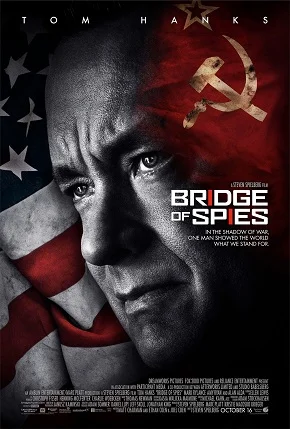
I’m going to be honest here and admit I did not know “Bridge of Spies” was a Steven Spielberg film before the credits rolled at the end of the film. As soon as I saw the famed director’s name though, it all made sense. Spielberg films perfectly walk the line between thrilling and comforting — and “Bridge of Spies” is no different. The film, starring Spielberg favorite Tom Hanks, takes on a small (but important) story in America’s history with heartwarming humor and provides us all with a reassuring look at the many faces bravery can take on.
“Bridge of Spies” is the “based on true events” tale of James B. Donovan, an insurance lawyer who is called to serve his country when he is asked to defend accused Soviet spy Rudolf Abel (Mark Rylance). It’s a job no one wants — the country’s extreme distaste for anything Soviet related means defending Abel is equivalent to treason — but Donovan gladly takes on the case, citing that every man brought to trial deserves due process. As Abel’s trial moves forward, a separate story involving the CIA’s new spy plane technology comes into play. The two stories meet when an American pilot is captured after his spy plane is shot down while on a mission over Soviet territory. Donovan is sent to East Berlin to negotiate the return of the American pilot, in exchange for his client, Abel.
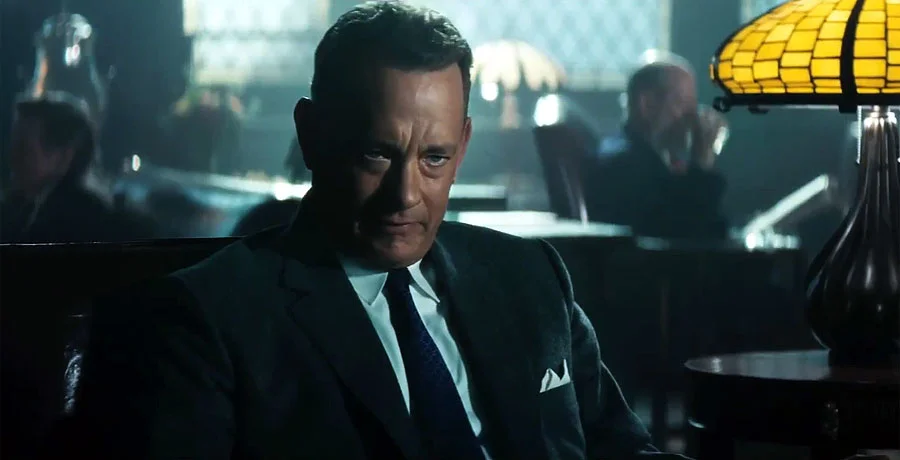
Aesthetically, “Bridge of Spies” is a dark film. The film plays out in dimly lit offices, the frozen streets of Soviet Russia, and a decent amount of prison cells. What’s so great about the film’s dark cinematography is that it lulls you in to unexpected humor and tender interactions between certain characters that really shines through. For a movie about one of America’s darkest moments in time, there were a decent amount of laughs. It is refreshing to see a historical film that seems to really take some time to focus on comedic writing and timing. Much of this is due in part to the brilliance of Tom Hanks, but his performance would not have worked had the film not decided to balance out its darkness with a little bit of light.
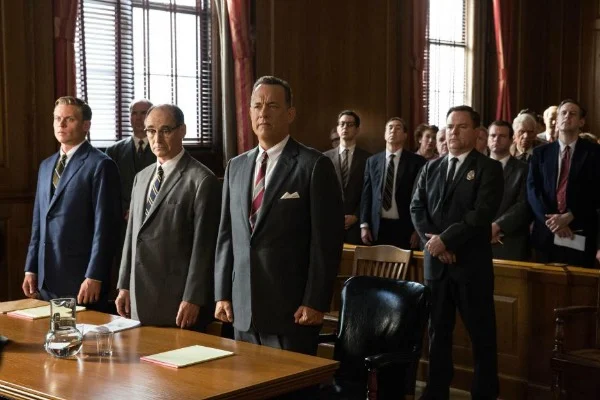
Another area where the film succeeds is its take on the Cold War’s defining characteristic: intelligence gathering. As the film notes, the Cold War was a war of information rather than one built on human sacrifice. There are no large battle scenes to be played out in a bloody, glorified mess — instead, the war takes place on a much smaller, intimate scale. Battles scenes are replaced by intense conversations in back offices and sketchy hotel rooms — and the effects of this war seem to take on a new meaning without the physicality of war to emphasize it. Between Donovan’s interactions with his family, the close relationship he develops with his client Abel, and his dedication to bringing home an American soldier, the film really brings the idea of “war” down a notch, making a hero of Donovan without trying to hard to do so.
With Oscars on the brain, I think it is safe to say that “Bridge of Spies” will be garnering at least a couple of nominations — historical films are always a hit and this one has all the tell-tale signs that it will be celebrated as such. What’s even better is it has real entertainment value. Besides, what could be better than two hours spent with Tom Hanks?
Grade: A