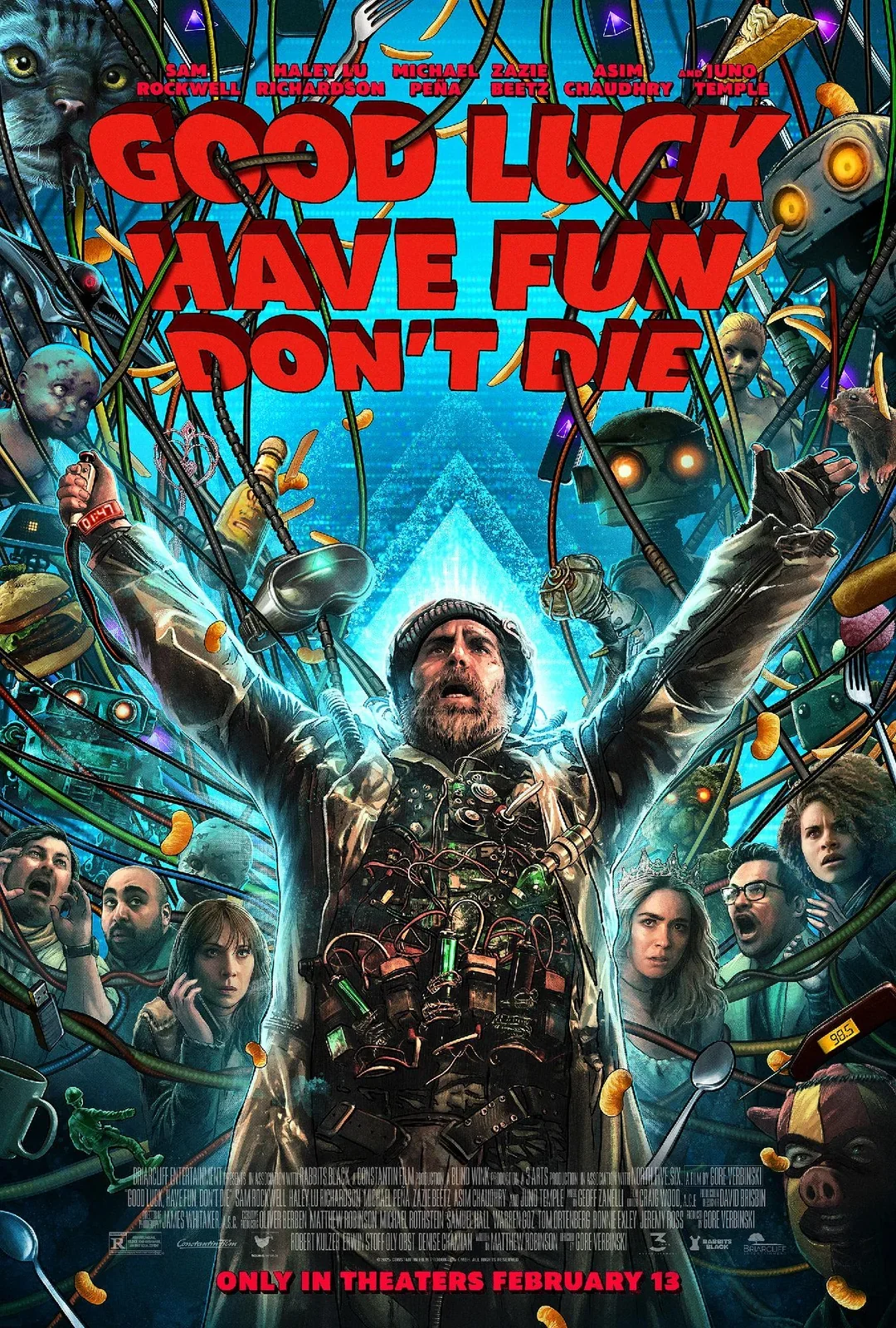
"Good Luck, Have Fun, Don't Die" Review: A Message From A Plausible Future?
There’s nothing like being in the hands of a director that has a vision for the story they want to tell. Director Gore Verbinski’s Good Luck, Have Fun, Don’t Die is one of those films. This one had me from the beginning with a closeup of a bottle of Cholula, because it told me further smart choices would be made from this director! (Cholula should be everyone’s hot sauce of choice.) In all seriousness, the opening imagery is a visual spectacle that should be studied in regard to taking a scene we’ve seen a million times and making it interesting. Admittedly, it goes off the tracks in Act III, but it’s refreshing to see a film that swings for the fences!
In a world where people are addicted to their phones, will anyone speak out against it? Hmmm, it sounds like our present day and writer Matthew Robinson obviously has something to get off his chest with his messaging of how we currently live with tech in the story that ensues. In the film, The Man From The Future (Sam Rockwell) bursts into a crowded LA diner to preach a message about the dangers of our technological addiction. The Man’s goal is to find the right combination of people in the diner who will come with him to stop humanity’s impending apocalyptic future. It’s a future in which AI has it out for humanity. Yes, it sounds like The Matrix meets The Terminator but this takes a more eccentric, fantastical approach to its storytelling.
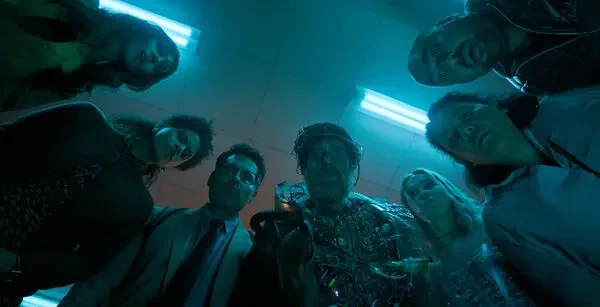
As the rag tag group of patrons, made up of Susan (Juno Temple), Ingrid (Hayley Lu Richardson), Mark (Michael Peña), Janet (Zazie Beetz) and Scott (Asim Chaudhry), are assembled for the over one hundredth time, it becomes clear that The Man seems to know a lot about each patron; this sparks their curiosity to follow him on the journey. Once the film gets going, we get the backstory of each patron. The stories interweave into a clear picture of the motivations for why this just might be the group that saves the world. Will they?
The strength in this film lies in the script. We’ve all probably had a moment where we come out of a doom scroll, had an instance when we look around a restaurant at other tables with people looking down at their phone instead of at each other, or found it strange that what we just said out loud is now an ad presented in our feed. Robinson takes these moments and throws a mirror up to say “this is where we are headed”. It’s a picture of the disconnected, cold-hearted society that we could easily become. It’s a world where a school shooting is an everyday run of the mill thing, classrooms are full of students where phones are stuck to their hands and it gets darker from there. It’s a film that, as a film critic, it forces you to stop taking notes and go for the ride.
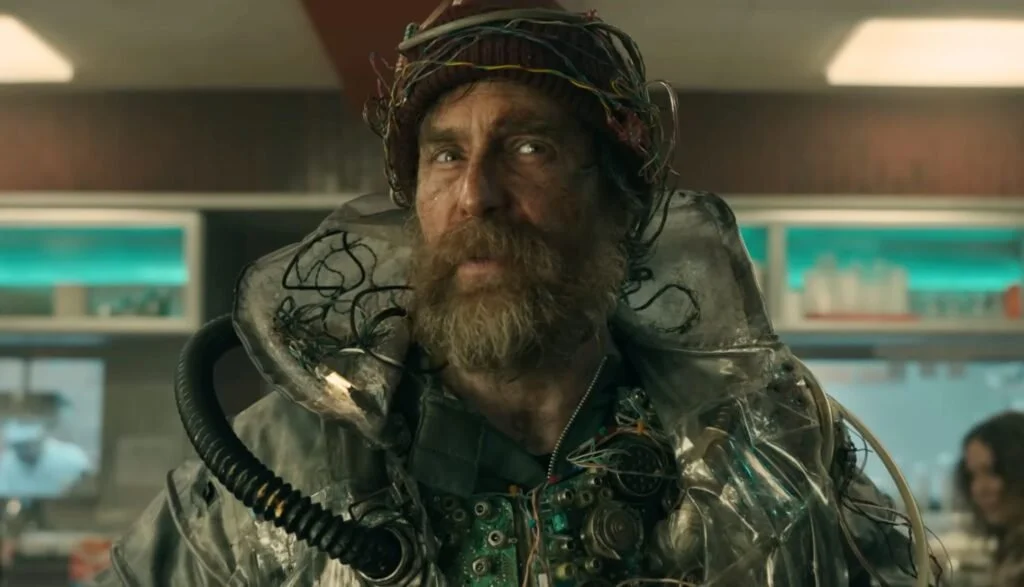
Let me be clear, this film gets bonkers. Sam Rockwell does a lot of the heavy lifting in landing on a protagonist that we can follow through his delivery and nuanced performance. The ensemble cast does their part as well, but this feels like vignettes of “Black Mirror” turned into a dark comedy movie over the course of its running time. Robinson’s message is loud, reminiscent of Boots Riley’s Sorry To Bother You, but doesn’t land as sharply. Verbinski and cinematographer James Whitaker paint a picture of a pretty world that doesn’t realize how ugly it is with the camera and light. That’s what resonates and translates. Society never gets to a bad place overnight. It’s the slow burn into apathy that gets us there. If you’re a fan of quirky, adventure, sci-fi films with a message, this might be worth seeing in theaters this weekend.
Rating: B-

"The Best Of Enemies" Review: Another Been There Seen That Blockbuster on Race Relations
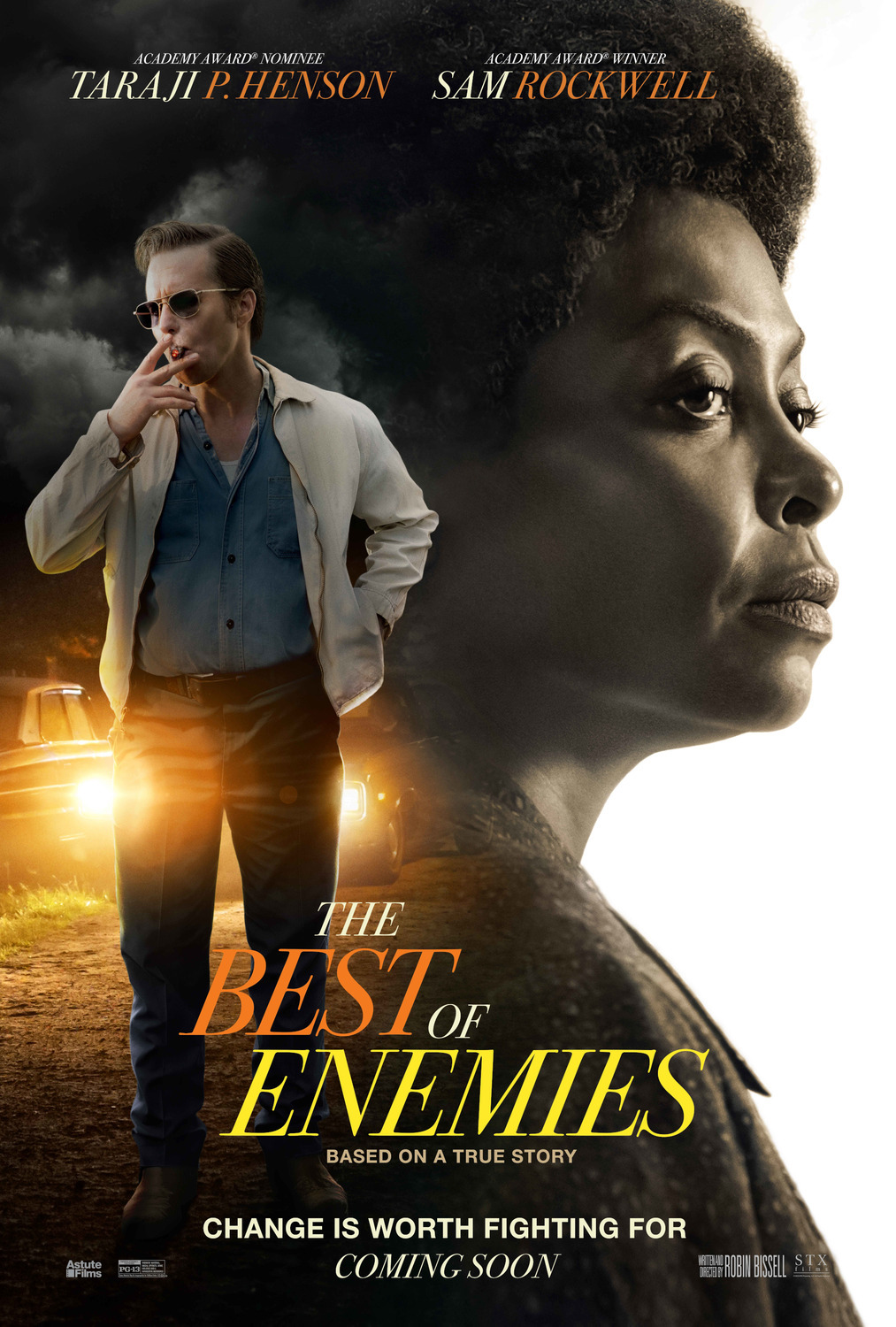
If you’ve seen a blockbuster Hollywood film dealing with race, you’ve seen The Best of Enemies. You can expect to learn more about the white antagonist than the black protagonist, whose weight in the true story is equal or greater to the other. The heart of the message, as it usually is, is definitely one that is good and should be celebrated. The problem is, with the same old screenplay structure, this film is still preaching to the choir and not digging deep enough to give us a sense of hidden figures in our nation’s history.
The film is set in 1971, when C.P. Ellis (Sam Rockwell) was the Exalted Cyclops of the Durham, North Carolina klavern of the United Klans of America. Ann Atwater (Taraji P. Henson) was a fair-housing activist at the time, trying to fight for the treatment of African-American residents in the community. After the segregated black elementary school burns from an electrical fire, the community has to decide whether to integrate the white school or not. Bill Riddick (Babou Ceesay) is brought in from Raleigh to conduct a charette, a deadline driven time of planning or activity, in order to bring the city to a conclusion.
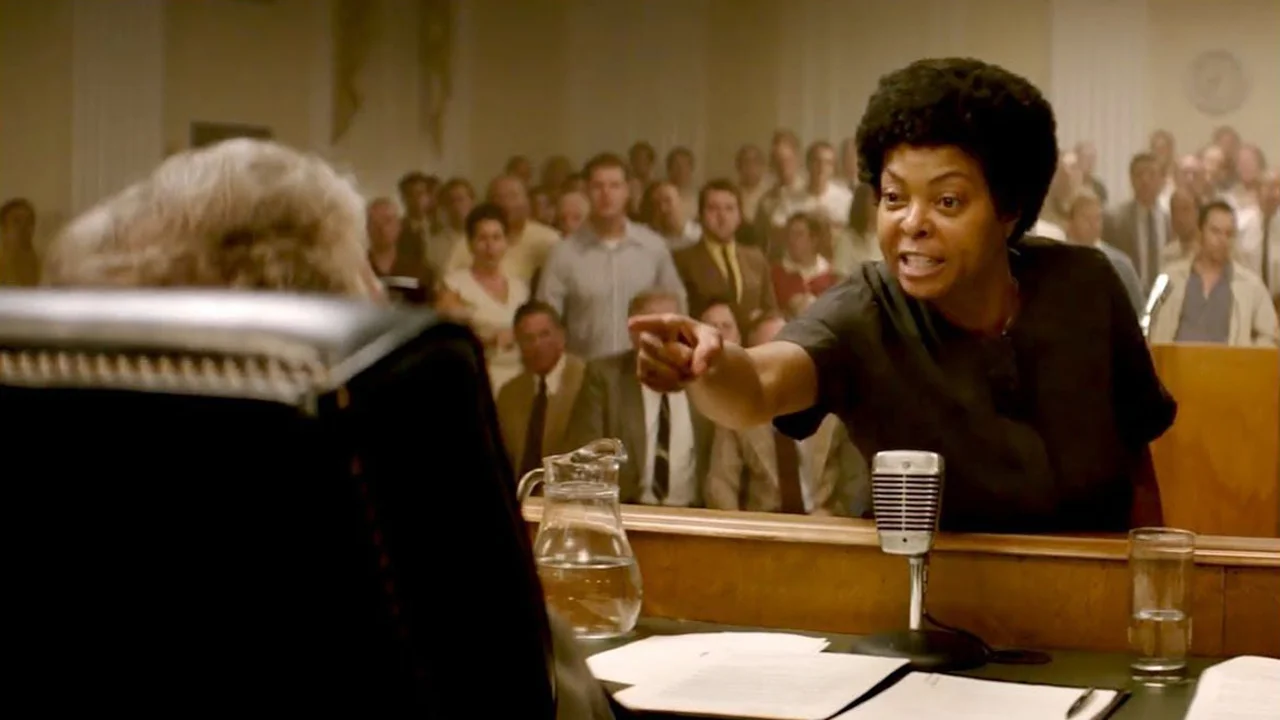
The film builds Ellis’s character early on by showing him and fellow klansmen shooting up a home of a white woman who is dating a black man. “Wait for the light!” C.P. says. They shoot through the bottom floor of the home to intimidate her as soon as the light upstairs is turned on. It’s an interesting look from the inside of the Klan as to how they’re doing their “job”. Ellis also has a son in a mental hospital who he visits regularly and pours love into. So it’s evident that he understands loving someone who may be different, but is staunch in his racist thinking. Atwater is always breathing hard. It could be because she’s overweight, but there is a sense of anger brewing under the surface with her that comes from years of hard work and hard living. While she’s not afraid to talk to the city officials who don’t care what she has to say (one turns in his chair to give her his back during a hearing) Atwater means business and expects them to listen.
The elements of a dynamic drama are there. There is an internal clock within the film that pushes the movie forward. You have a man who hates black people but loves his family and a woman who advocates for black people by speaking truth to power on a daily basis. The question becomes, how did they go from enemies to having the kind of friendship in which Atwater delivered the eulogy when Ellis died in 2005? It’s this deep study in character development and human interaction that writer/director Robin Bissell misses the mark on in exchange for symbolism over exhibiting the internal reflection/change of his characters.
Throughout the film, social class is represented through clothing. The rich and educated wear suits and nice clothes in the film, while the “common folk” wear button ups and dresses thin enough for their sweat stains to seep through and make sure we know they work hard. In fact, the rich don’t ever seem to sweat in a community that seems to be hot as evidenced by Atwater’s constant use of a handkerchief to dab away her sweat. There is a surface level exploration of the politics of the town that would give the viewer an inside look at why tensions exist amongst the the groups represented in the film.
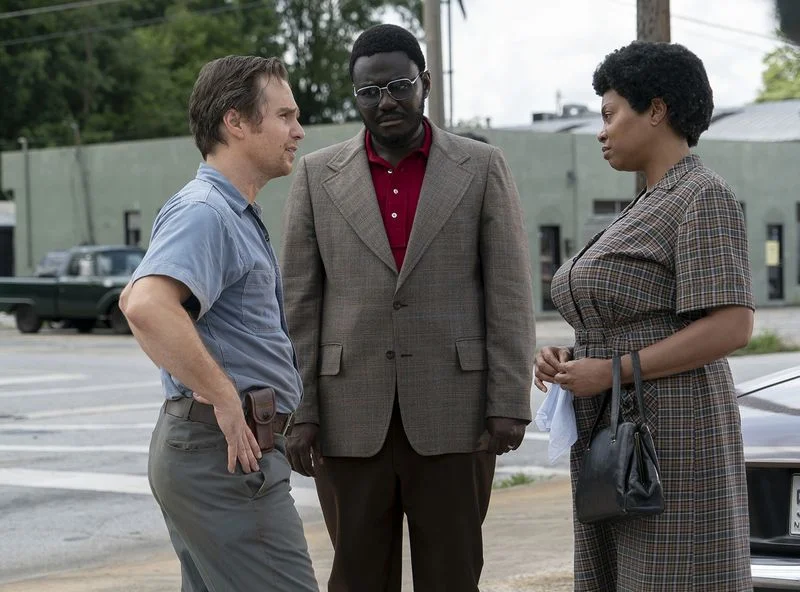
Atwater does a nice thing for the Ellis family, unbeknownst to them, which simply serves as an example of being kind even when someone is mean to you. At the end of the charette, Atwater gives a one sentence answer in whether the schools should be integrated or not. We get a monologue from Ellis for his decision to do what we knew was right from the beginning. There is a disproportionate amount of focus and backstory on both characters in this film, and that has to stop.
If The Best of Enemies had never been made, the vast majority of people who see the film would never know about Ann Atwater and C.P. Ellis. So there has to be some credit given to the people who brought this movie to life. However, if we’re going to have stories dealing with race and overcoming prejudice in our history, let’s do it the right way! Taraji P. Henson and Sam Rockwell brought it as their characters, but perhaps the same equality their characters were fighting for should be brought to similar screenplays in the future!
Rating: C
My Video Review:

"Three Billboards Outside Ebbing Missouri" Review
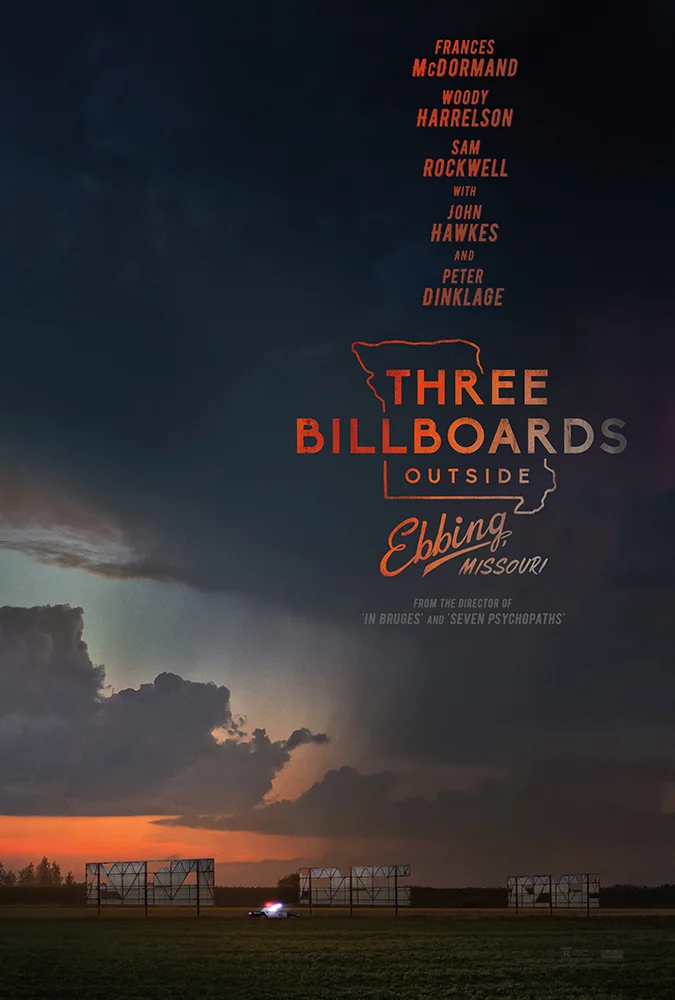
Three Billboards Outside Ebbing, Missouri is a white knuckle of a film. The newest film from writer/director Martin McDonagh, who previously helmed 2008’s In Bruges and 2012’s Seven Psychopaths (both of which I enjoyed a lot). He’s back with a timely film. With the subject matters at hand with the film, it could have gone one or two ways: either skim the surface or be overly exploited, but with McDonagh at the helm, he turns the film into something even more. In short, this is one of the very best films that I have seen in the theaters this year!
Mildred Hayes (Francis McDormand) has had enough. It’s been close to a year since her daughter, Angela, was murdered. No arrests have been made or any suspects questioned, and it has become a cold case. To take matters into her own hands, she decides to rent three billboards outside of the town, but close to her home, to call out Sheriff Bill Willoughby (Woody Harrelson) for lack of progress. With this, Mildred hopes that it will put pressure on the police to finally solve the case. And that’s just the tip of the iceberg of what the film explores.
Three Billboards is a hot button film that presses on a lot of issues, especially in today’s climate. Some of the issues include racism, police brutality, and sexual assault. McDonagh touches on these subjects greatly and doesn’t hold back about his views on these, yet he never hits you over the head with what’s he’s trying to say. Similar with In Bruges and Seven Psychopaths, the writing is brilliant and darkly funny at times. McDonagh knows how to balance the comedy with the drama that thankfully, the comedy doesn’t overshadow what’s transpiring on screen. It’s funny when it needs to be funny. McDonagh also does a great job in rounding out the characters in that they all feel three-dimensional and each has their own personality. By the end of their introductions, you know exactly who the characters are and how they act around people. In fact, it’s easy to identify with the characters and believe in the actions they take throughout the course of the 115-minute runtime. Behind everyone’s façade, McDonagh shows us the pain that they face, whether they face their demons externally or internally.
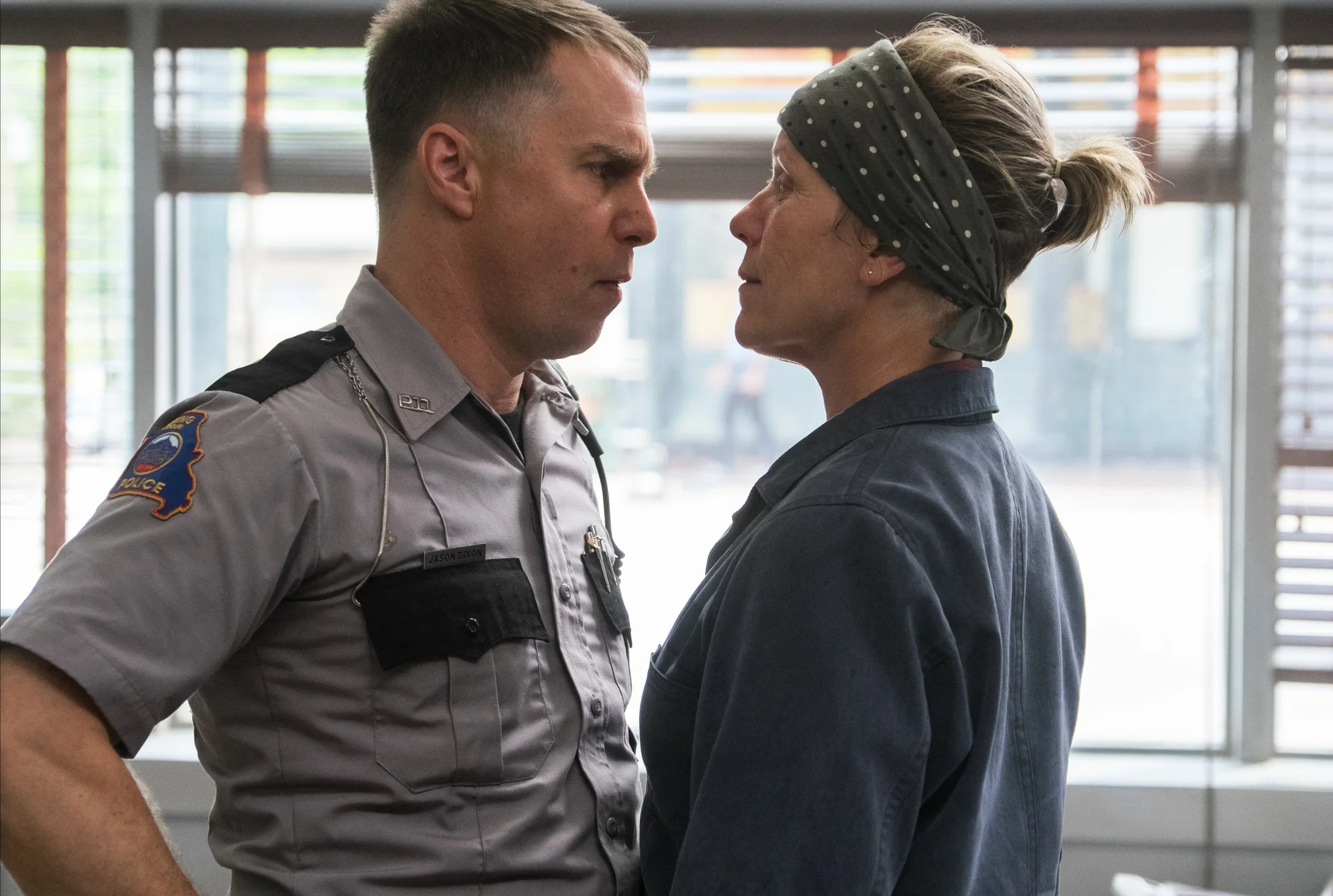
Acting wise, everyone shines in this. McDormand gives a fearless performance as Mildred, who’s just trying to find the answers to her daughter’s murder. She’s headstrong and sometimes a bull in the china shop. This might be the best role that she has had in a long time! In particular, a scene that involves her and the local priest that may just be one of the best-written scenes in a film this year. Harrelson (reuniting with McDonagh after Seven Psychopaths) puts in good work as Sheriff Willoughby. At first, you don’t know how to feel about him, but you quickly will. By far, the best performance from the film belongs to Sam Rockwell (also returning from Seven Psychopaths) as Officer Jason Dixon. It’s a powerhouse performance that Rockwell gives as a character who’s vile, despicable, insensitive yet sympathetic towards the end of the film. Rockwell’s the MVP of the film, and this is the type of role that could finally be his breakthrough performance. Don’t be surprised if he gets some awards love this season.
If there are any drawbacks that I had with Three Billboards, some of the characters could have been left out of the film or fleshed out a little bit more. In particular, while I’m a fan of Peter Dinklage, the subplot between Mildred and his character goes nowhere, and he’s basically not in the film enough to leave an impression. Likewise, there are scenes that run in circles and should have been condensed or left out entirely for a much tighter film. Because of these scenes, the pacing feels a little off at times.
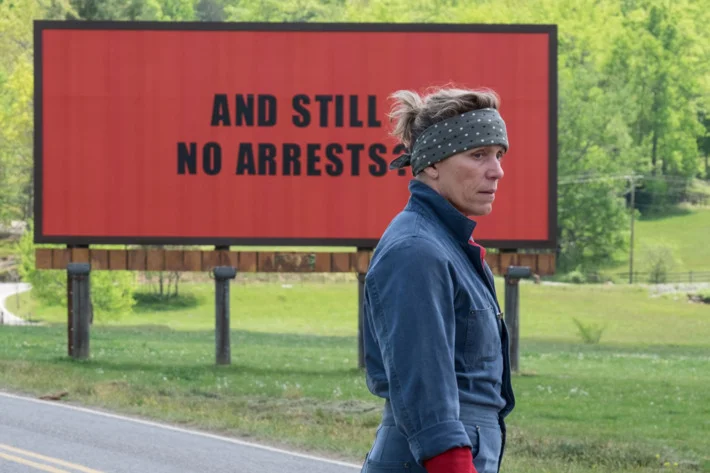
Overall, Three Billboards Outside Ebbing, Missouri is a film for the here and now. This is a film that I enjoyed way better then what I was hoping for going into the screening. It’s a film that will stay with you long after you watch it. I hope that this film will spark discussions about what people saw on screen, including the ending that will surely be up for debate for years to come. With this film, McDonagh makes us confront what’s going on today in America. It’s angry and raw at times, but pushes for people to be held accountable for their actions. All we need to do sometimes is talk to the other side or see the world from a different perspective. This might just be McDonagh’s best film yet as a filmmaker. It’s one of the best films of the year, and a treasure. You should absolutely see this in the theater ASAP.
Rating: A