
"The Harder They Fall" Review: A Refreshing Western Genre Entry
The Harder They Fall is a stylish, fully realized vision from co-writer/director Jeymes Samuel. Rooted in the western genre it borrows French New Wave characteristics as well. With a stellar cast, engaging dialogue, and a bumpin’ soundtrack, this movie is not only an entertaining watch but memorable as well. With a predominately black cast, the film tells a fictional, swagged-out tale of real-life black cowboys who once roamed the American West.
The film starts out giving us the backstory of Nat Love (Jonathan Majors) as a child. After witnessing the murder of his parents and receiving a scar from Rufus Buck (Idris Elba), we find Nat as an adult years later on the path to finishing his revenge. Layered through this journey we’re introduced to Mary Fields (Zazie Beets), Bass Reeves (Delroy Lindo), Trudy Smith (Regina King), and Cherokee Bill (Lakeith Stanfield) amongst other notable/familiar faces. That’s about all I’ll reveal as far as the plot goes because how the story unfolds is where so much of the enjoyment lies.

There are way too many beautiful shots to talk about in this film but let’s dig into a couple. In a scene where Cherokee Bill is introduced to us, he slowly glides down the center of the train, center framed while the rest of the gang is blocked by his head. He gives a young boy an alternative telling him to “put the gun down or we’ll kill everyone on this train”. When no movement is made, Bill draws his weapon and simultaneously arms from fellow gang members shoot out of his head in the background. This camera placement and blocking of the actors conveys the danger while showing us in one shot, a stylistic but thoughtful use of framing. This is consistent throughout the film as Samuel uses his camera to show instead of tell.

Samuel takes his framing even further with the use of music and sound. Whether it’s pushing in on a character to the thump of a gun hitting the floor or the kick of a drum in the soundtrack, there is intentionality on full display. Two percussion hits reveal one character behind another in step with a camera move to the right. Samuel’s chucking of conventional framing and attention to the fact that we, the audience, are aware we’re watching a movie, has French New Wave written all over it but shows his creativity in constructing a movie that draws on western genre traits while being refreshingly unique.
Cinematographer, Mihai Malaimare Jr. (The Master, Jojo Rabbit) adds his gift of painting with light to the film. The colors in each scene are vibrant while shifting from cool to warm temperatures with ease. Understanding when to implement the shift in palettes may be missed by the average viewer, but it builds this story to perfection. When a character tells something from their past, warm colors are used to bolster the vulnerability of discussing an old memory.
The dialogue in this film is handled masterfully in its delivery from each main cast member. Silence is used where it’s needed to allow the visuals of the film to speak for themselves. If someone speaks, it's important to the forward progression of the film’s storytelling. Otherwise, nothing needs to be said. The southern drawl or New Orleans accent of characters not only rings authentic but serves as a layer to this delicious cake of a film. Each cast member gives nuance and life to their role. To highlight one individual performance would slight this ensemble of no weak links. The soundtrack of the film fills in the role of an additional, unseen character, telling a part of this tale. Turn on the subtitles and you’ll see the lyrics align perfectly with each scene they are heard in.
At a two hour and ten minute running time, you won’t notice it. The Harder They Fall is engaging from start to finish and if we got more from this world we’d be lucky! Grab your popcorn and turn on Netflix as soon as you can!
Rating: A
"The Homesman" Review
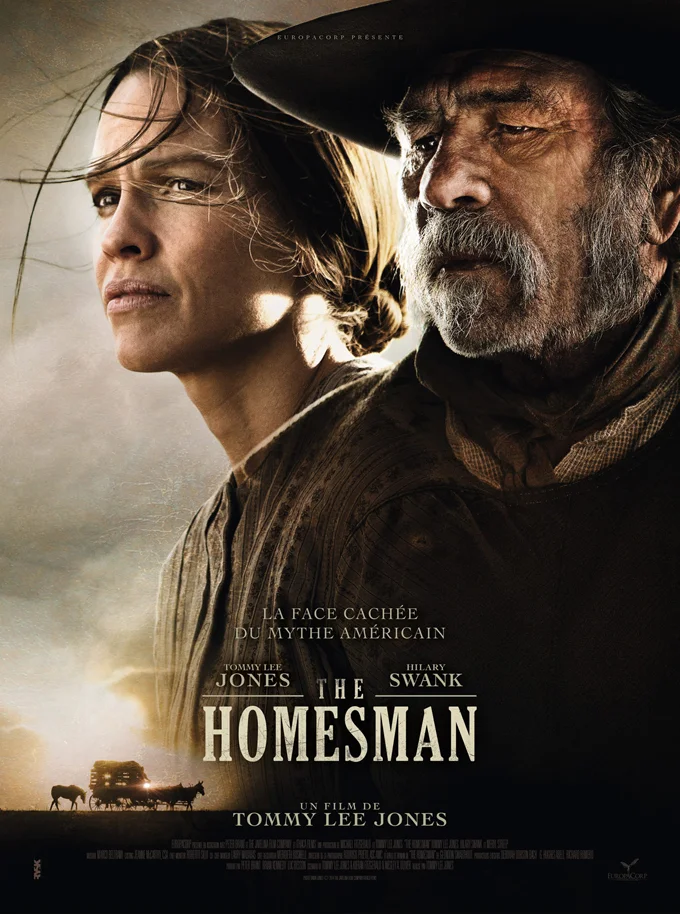
“The Homesman” isn’t a glamorized western. Writer/director Tommy Lee Jones gives us an authentic look at what life on the western frontier was like, and a feminist critique of the genre/time. It’s a tough movie for most people to sit through and swallow, but it’s guaranteed to give you something to chew on after the closing credits.
Hillary Swank is Mary Bee Cuddy, a 31 year old, principled, hardworking single woman. Whatever happened up until this point in her life, it’s obvious that her work ethic has brought her the “American Dream of the time” minus a husband and kids. In the opening scenes of the film, Bob Giffen (Evan Jones), the local single man likely to be her suitor, gives her the adjectives of “plain and bossy” as the reason he won’t marry her. She’s obviously far from plain, amassing her own lot and cattle on the edge of the unknown of U.S. territory. She’s what you may call an independent woman today, but she’s referred to as an “uncommon” woman in the film.

When three women in their small town take a mental turn for the worst, no man has the guts to make the journey back east to take the women to a place where they can receive care. Mary Bee does. She secures the help of George Briggs (Tommy Lee Jones) after saving him from death by hanging. George is an unkempt, self-centered drifter; he’s everything Mary Bee is not. While Mary Bee is on a mission to ensure the safety of the three women, George is on a mission to earn $300 for assisting with the “cuckoo clocks”.
Each woman being transported has their own issues wrapped in feminine disenfranchisements of the time. Gro Svendsen (Sonja Richter), a Norwegian woman who has been repeatedly raped by her husband in an effort to give him a son, howls and bites at anyone who comes near her. Arabella Sours (Grace Gummer), only 19 years old, doesn’t move much or speak. She just holds on to a rag doll that subs for the three children she lost to diphtheria. Theoline Belknap (Miranda Otto), drowned her own baby in an outhouse.
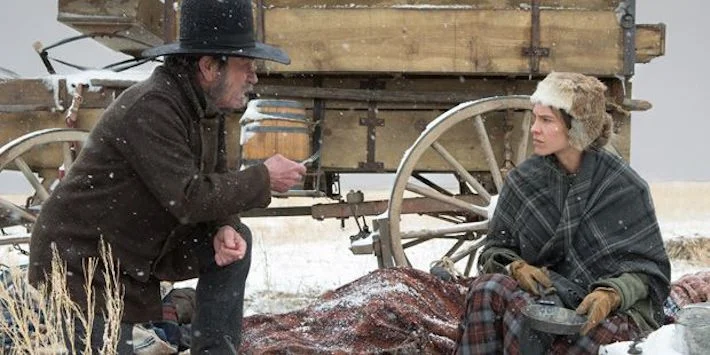
As the group makes the journey east, it’s clear that nature itself is not going to make it an easy ride. Winter is brutal, nights are cold, food is scarce, and bridges haven’t been built to walk over streams or rivers. The harsh reality of survival during that time is made clear as each day passes in the film.
Jones is able to put a magnifying glass on the time and deconstruct the role that women and men played throughout “The Homesman”. While he pushes for feminist context, he trips over it by missing wonderful opportunities for female empowerment. As the duo gets closer to their destination, Mary Bee, despite all of her wonderful qualities and material possessions, feels incomplete as a woman without a husband and makes choices that shatter her weight in the film. All of the women in the film have an identity that is closely associated to a man or lack their of.
“The Homesman” shows us that the frontier was a man’s world. A strong moral compass could get you killed, and self-interest would help you thrive during that era. Jones’ statement on women during the time is made clear throughout the movie, but fell short of something remarkable. Regardless, the film is memorable, and will make you grateful you only had to watch a movie about the frontier rather than live it out.
Rating: C+