
"Moonlight" Review
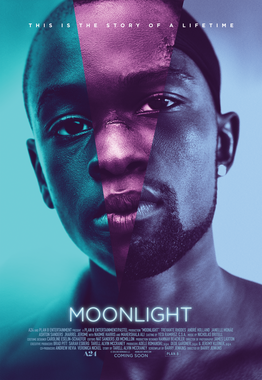
The buzz about Moonlight started after its premiere at Telluride. Since then, it’s been one of the most sought out films on the festival circuit. And it should be. Moonlight is a magnificent film that doesn’t exploit itself or its message. Instead, it simply tells us a story of beauty, bittersweet irony that allows us make our own decisions and conclusions.
Told in three parts of a man’s life, the film begins with a nine year old Chiron (Alex R. Hibbert) who is called Little. Director Barry Jenkins instantly makes us relate and sympathize with the main character in a heart-wrenching scene in which Chiron is chased by the neighborhood kids into an abandoned building. As Jenkins camera hovers over Little like the bullies he runs from, Jenkins also uses sound to put us in Little’s world. A cacophony of inaudible yelling and knocking on the door torments our ears, as it does Little.
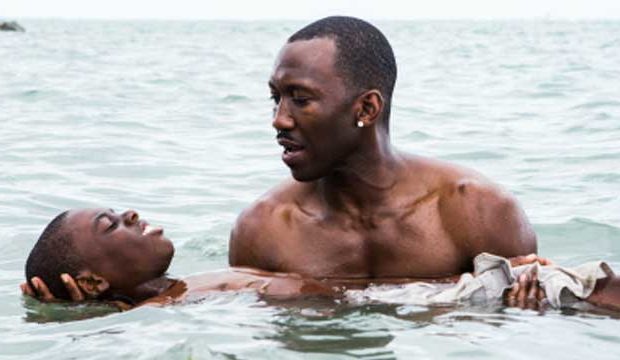
Juan (Mahershala Ali), the kingpin drug dealer of the block, looks after Little, who doesn’t speak accept for when he’s being fed. After trying to reunite Little with his mother (Naomie Harris), Juan quickly finds out that she’s one of the fiends that he serves. From then on, Juan and his girlfriend Teresa (Janelle Monae) take care of Little when his mother neglects him for whatever reason. So when Little asks Juan “What’s a faggot?” due to bullying, there is an incredible dynamic between the machismo of Juan and the innocence of Little. The beauty in watching a crack dealer provide love and support for a young child while ironically continuing to kill his mother slowly are some of the touches that the movie offers up, with no judgment.

As Little grows into Chiron (Ashton Sanders) the teenager in the second act, the bullying hasn’t stopped. In fact, it seems like a state of the way things are. Chiron’s only friend is Kevin (Jharrel Jerome), who has been his friend as a child, but is now a pretty boy and ladies man. It’s in the story of teenage Chiron that we see a point of intersection between the first time he has a sexual experience and when he’s decided he’s had enough of the bullying. This takes us into the final act of the film where we meet Black (Trevante Rhodes), the muscle bound shell of machismo that Chiron has built himself into.
The entire cast of Moonlight does an outstanding job! Mahershala Ali gives Juan the iron fist and open hand that’s needed for us to see the irony in the first act. Harris’s Paula is the only character to be in each act as a steady force in Chiron’s life whether for good or bad, and it stings. Each version of Chiron and Kevin throughout the years bring something different to the table, building off of one another and handing off the baton in a perfect relay race. In the Q&A after the screening I saw of the film, Jenkins said that he never allowed the actors to meet. Knowing that, makes the film that much more impressive.

Based off of the play by Tarell Alvin McCraney, Moonlight tells a story that’s rarely heard in regard to black male sexuality and displayed without drama. Without ever using the word gay or having a coming out moment, the film simply shows. Jenkins use of restraint and excellent craftsmanship will definitely put Moonlight in the ring during awards season!
Rating: A

"Snowden" Review
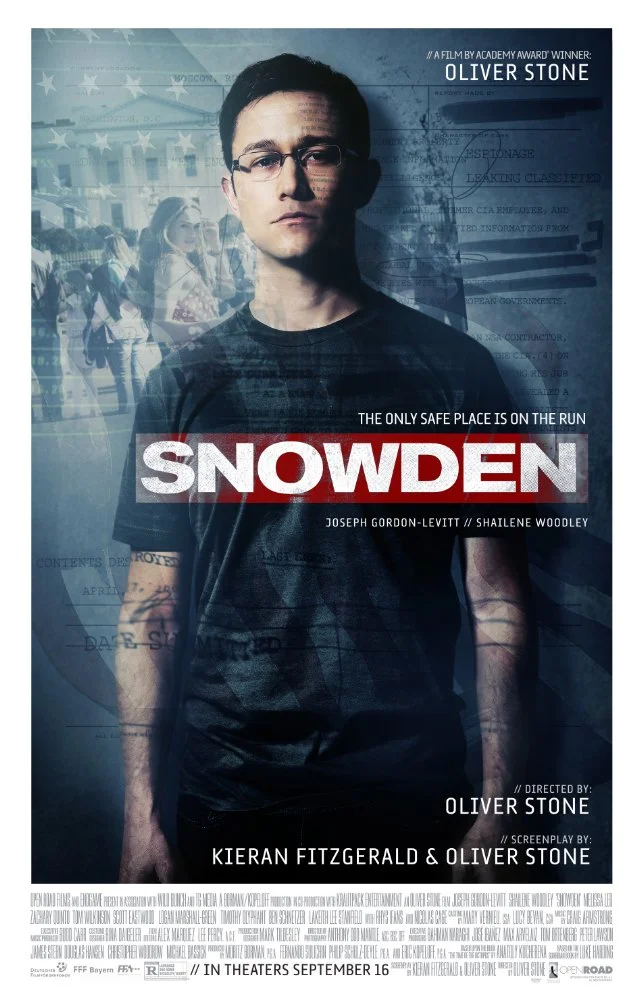
I’m not quite sure if Joseph Gordon-Levitt is purposefully taking biopic roles in which a documentary of the same subject comes out prior (Snowden is to Citizenfour as The Walk is to Man on Wire) and covers it better or it’s pure coincidence. Either way, in both instances he’s fully committed to the role. While Snowden has great moments, there are a lot of deflated scenes that string them together.

The film starts with Edward Snowden (Joseph Gordon-Levitt) in training to become a member of the Special Forces in the US Army. After breaking his legs, he’s not able to complete training and eventually joins the CIA. From there the film quickly journeys into Snowden’s rise in the intelligence community. He’s a brilliant programmer who catches the eye of Linsay Mills (Shailene Woodley) along the way.
As Snowden’s clearance levels expand, he starts to notice programs that encroach on privacy of people. His moral compass keeps him on the straight and narrow, while many around him either turn a blind eye or have suffered the wrath of speaking up. Hank Forrester (Nicolas Cage) is one of those mentors, banished to what looks like a high school science/computer lab in the CIA, who serve as a visual as to what happens to those who don’t play by the rules.

With the decision to be quiet or speak in front of him, Snowden chooses to contact documentary filmmaker Laura Poitras (Melissa Leo) and journalist Glenn Greenwald (Zachary Quinto) to wisely set up a meet in a hotel room in China to give the truth before the media machine can shut him down. This part of the film is where the documentary Citizenfour centered and covered beautifully. Here, it’s not unveiled as smoothly.
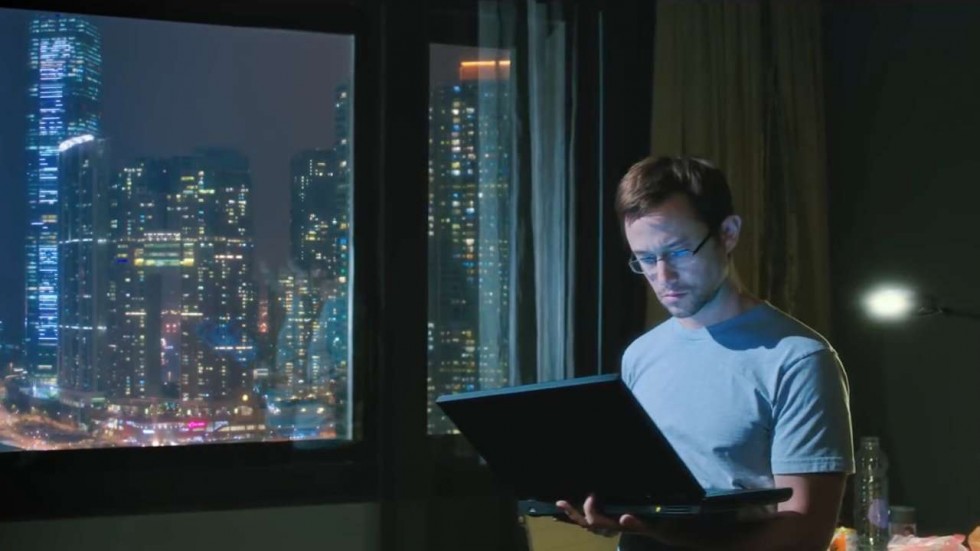
Let it be known that Joseph Gordon-Levitt wears Snowden on his shoulders like a rucksack and fights to carry it toward being a film worth seeing. He executes the role with a laser-like focus and care for the character and telling his story. Quinto and Poitras give poignant performances that add to the weight of Snowden’s decision to come forward. Unfortunately, Woodley’s Linsay is forgettable, a character piece placed in the film for conflict with the main character. The pacing of the film, jumping through time, checks off the biopic “must cover” list and director Oliver Stone is able to create the sense of pure paranoia that one would expect to feel in going against the most powerful country in the world.
I don’t think a based on a true story was necessary, and its message is muddled in explaining counter surveillance at times. However, Stone’s film does not shy away from promoting real life document leaker Edward Snowden as an American hero who should be commended, not chastised. Unfortunately, it’s in its slant that the ability to judge for yourself is lost. Which probably wasn’t necessary, because by the end of the first act you already want to turn off your phone and cover your webcam. Excuse me as I close my laptop!
Rating: B-

"Batman: The Killing Joke" Review
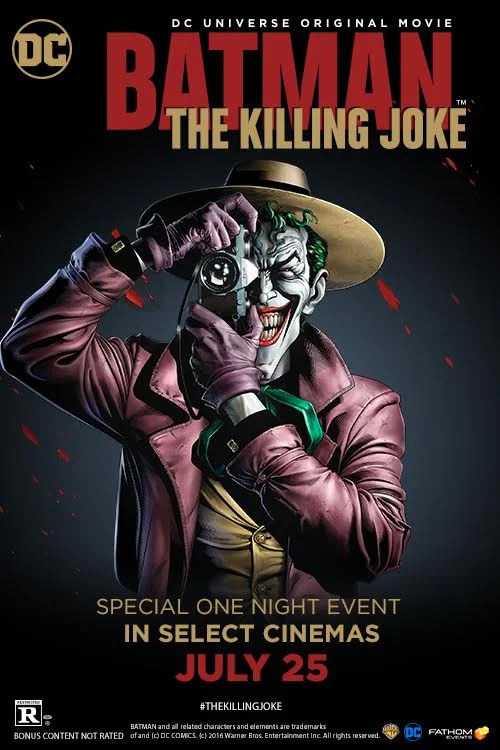
I won’t lie, I came to Batman: The Killing Joke late. I didn’t read it until this year when I heard buzz about the feature film. That doesn’t, however, lessen the power of the comic book’s impact on me. In fact, I’m pretty sure that it had the same impact on me that it had for folks in 1988. It’s raw, smart, and compelling. Unfortunately, the new feature film doesn’t compare to the force of nature that is the graphic novel.
The film starts out with a voice over from Barbara Gordon (Tara Strong), Commissioner Gordon’s (Ray Wise) daughter, telling us that she’s sure “this isn’t how you thought the story would start”. It isn’t, but we’ll go with it. For the next thirty minutes we see the relationship between Batgirl and Batman (Kevin Conroy) as they try to capture Paris Franz (Maury Sterling), a pompous sociopath. Perhaps this deviation from the source material was to establish Batman’s motivations for going after The Joker (Mark Hamil). Perhaps it was to set up future animated features. Whatever it was, it detracted from the overall story.
The prologue gives us a soap opera love triangle amongst Bruce (Wayne), Barbara and Paris. It paints a misogynistic image of an older man being pined after by a young love lorn coed. (Bruce and Barbara are closer in age than the film made it look like.) It’s a forbidden love story of a teacher and student that feels forced. Especially when Batgirl rips off her top (costume) and makes love with Batman high above the city.

Once the story we know takes off, it’s an entertaining film. Your mind goes between what you know from the comic book and what’s been added to fill in blanks. Hearing Mark Hamil’s voice as the Joker once again is great. It reminded me of all those days of grabbing a snack and watching “Batman: The Animated Series” after school as a kid. Hamil has fun playing the unpredictable equal of Batman, as evidenced in his delivery. Kevin Conroy lends his controlled, powerful voice to the role once more and sells Batman.

If you haven’t read the comic book, do it! It’s awesome! Ultimately, this feature film, like many movies adapted from books, can’t compete with your imagination. The mind is a powerful thing, filling in thoughts and feelings where the page’s frames doesn’t. It paints an incomparable cinematic experience! While the feature lifts some of the iconic panels found in Batman: The Killing Joke and puts them into motion, it can’t beat the original.
Rating: C