"Dark Places" Review
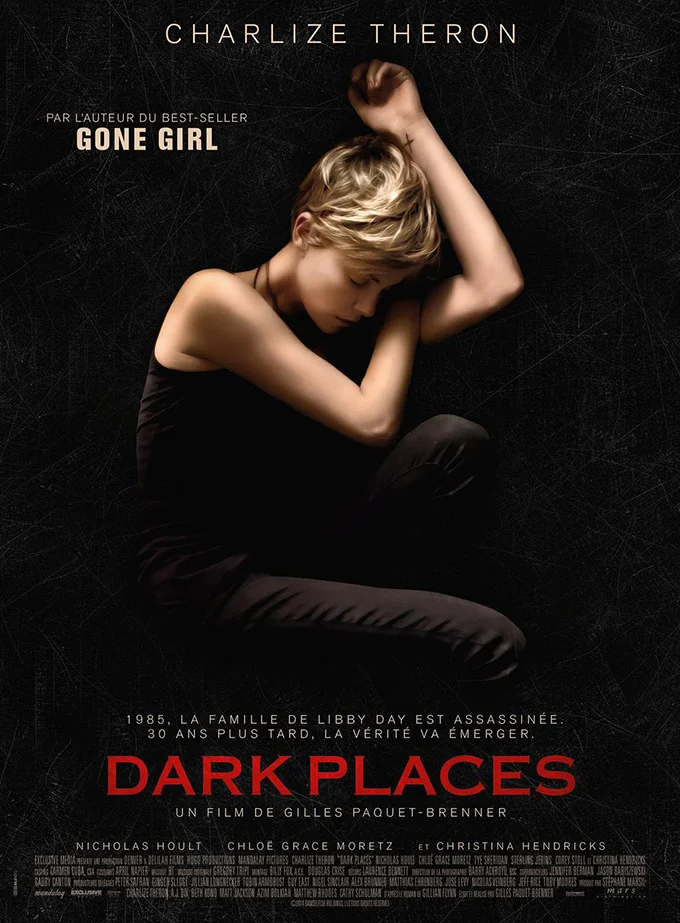
When a book becomes a movie there is always one main question: how will it compare? For Dark Places, there is a second, more challenging question: how does it compare to Gone Girl? Fans of Gillian Flynn have most likely read all three of the author’s spectacular books: Dark Places, Gone Girl and Sharp Objects. As an author, Flynn weaves tales of women facing a grim (often self-imposed) challenge. There are consistent themes throughout all three of her novels, creating quite the challenge for turning these books into movies, especially with Gone Girl’s critical success.
Dark Places is intentionally disorienting as the pieces of Libby Day’s past and present are brought to screen. Between grainy flashbacks, we meet current day Libby as she grapples with a dismal financial future. We learn that she has been living off donations from strangers who want to show their support after the gruesome murder of her mother and two sisters. Libby and her brother Ben survived that night — although Ben has spent many years locked away after being charged with the murders. Faced with a shrinking bank account (and no job to speak of) Libby turns to the Kill Club, a gathering of murder super fans, who are willing to shell out $500 bucks for her to make an appearance at their latest gathering. Much to Libby’s dismay, the Kill Club is not just a group of fans, they are vigilantes — hoping to prove that her brother Ben was wrongly accused of the murders. Libby’s financial motivation, coupled with the persistence of the Kill Club, get the story going and takes the audience back and forth in order to figure out who really killed the Day family.
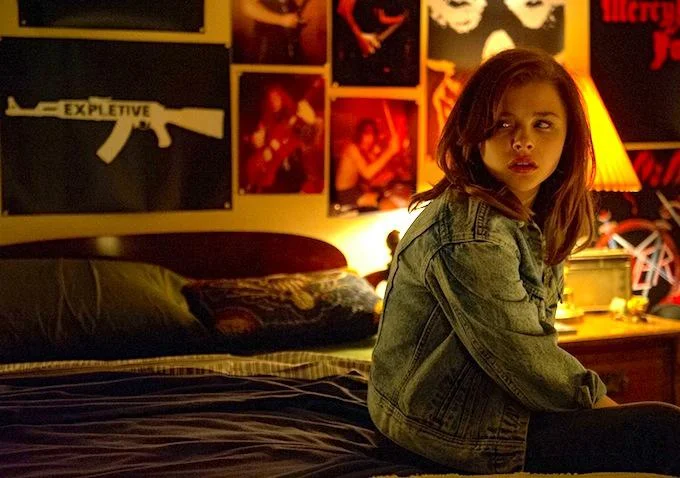
There is no doubt about it, the cast for Dark Places is stacked. Libby’s mother is played by Mad Men’s Christina Hendricks, the treasurer of the Kill Club is played by X-Men’s Nicholas Hoult and Drea de Matteo even makes an appearance as old classmate turned stripper. By and far, the most notable performance is delivered by Chloe Grace Moretz, who plays a teenage love interest of Ben’s. Moretz is a fiery scene stealer and this reviewer wishes the whole film was based around her character, Diondra. Charlize Theron plays present day Libby Day and delivers a “dark” performance, but at times she simply tries too hard. Moretz pulls off enigmatic Diondra naturally, in a rather frightening way.
Although Dark Places sprang from the same mind of Gone Girl, the two films simply do not compare. While Gone Girl takes on Flynn’s twisted tale with a cool and crisp approach, Dark Places feels clunky and all too aware of its purpose. Director Gilles Paquet-Brenner’s jerky camera movements and approach to the film’s major themes feel forced, put in as part of a checklist rather than as an artistic statement. Separating it from its Gone Girl counterpart, Dark Places does function as a somewhat thrilling, more decadent episode of Law and Order: SVU, which is always worth a watch.
Rating: B-
Denzel "The Equalizer"

“The Equalizer” is a slow burn that packs a mighty punch once it gets going. The combination of director Antoine Fuqua and Denzel Washington once again proves lethal. It’s the vigilante redemption story that we get wrapped up in, helmed by an actor we love to see.
Robert McCall (Denzel Washington) is a quiet, law abiding citizen who seems to have just recently started a new job at Home Mart (think Home Depot). He has a routine, he’s meticulous, can’t sleep through the night, and sticks to himself. Each night he visits a local diner and has tea while reading a book. It’s there that Teri (Chloe Grace Moretz), a call girl and regular to the diner, interacts with him. “Good things don’t happen in my world” she tells him. “Well you gotta change your world” McCall responds. This powerful advice is the theme of the movie. By choosing what you allow or don’t allow in your world you can bring peace or disrupt things. As Teri enters Robert’s world, his is altered and tainted by the lifestyle she has been forced to live and it takes him to a violent place he seems to be very comfortable and far to familiar with.

After Teri shows up in a hospital beat up and comatose, McCall decides to pay a visit to the men that gave his young friend a beating. He gives them a choice to let her go free from the lifestyle for $9,800. They don’t accept, and he rains down violent justice in 19 seconds flat. Unknowingly, McCall just took out the East Coast heads of the Russian Mafia. Enter Teddy (Marton Csokas), the sociopath genius that will be McCall’s biggest adversary. Honestly, you can guess how the rest of the movie goes as both sides square off like boxers to see what the other is made of. When they finally do meet face to face they have one of the greatest subtext dialogue (what they’re saying has other meaning) scenes I’ve heard in a while. Regardless of the familiar plot, it’s a suspenseful thrill ride to get to the end.

Fuqua is at the top of his game using the camera to speak visually and supplement his actors’ work. He has one of the coolest hero walk shots with Denzel blowing something up that I've seen in a while because it tells a story while being eye candy. While this wasn’t an Oscar worthy movie, like the two collaborated on in “Training Day”, Denzel has likely just turned in a franchise worthy performance! He holds down the vigilante justice role just as well as Liam Neeson. Honestly, I’d like to see Denzel in a Marvel or DC comic film. Half of the film I felt like he was Batman as he took out bad guys (mostly at night or in the dark) with an almost unkillable persona.
“The Equalizer” is an entertaining time at the movies this weekend and is sure to entertain action junkies! While Denzel’s smooth walk seems to have a slight sign of age to it now, by no means does that stop him from claiming the leading man spot for this genre. In fact, it’s probably elevated him to new heights as an action star!
Rating: B+