"No Escape" Review
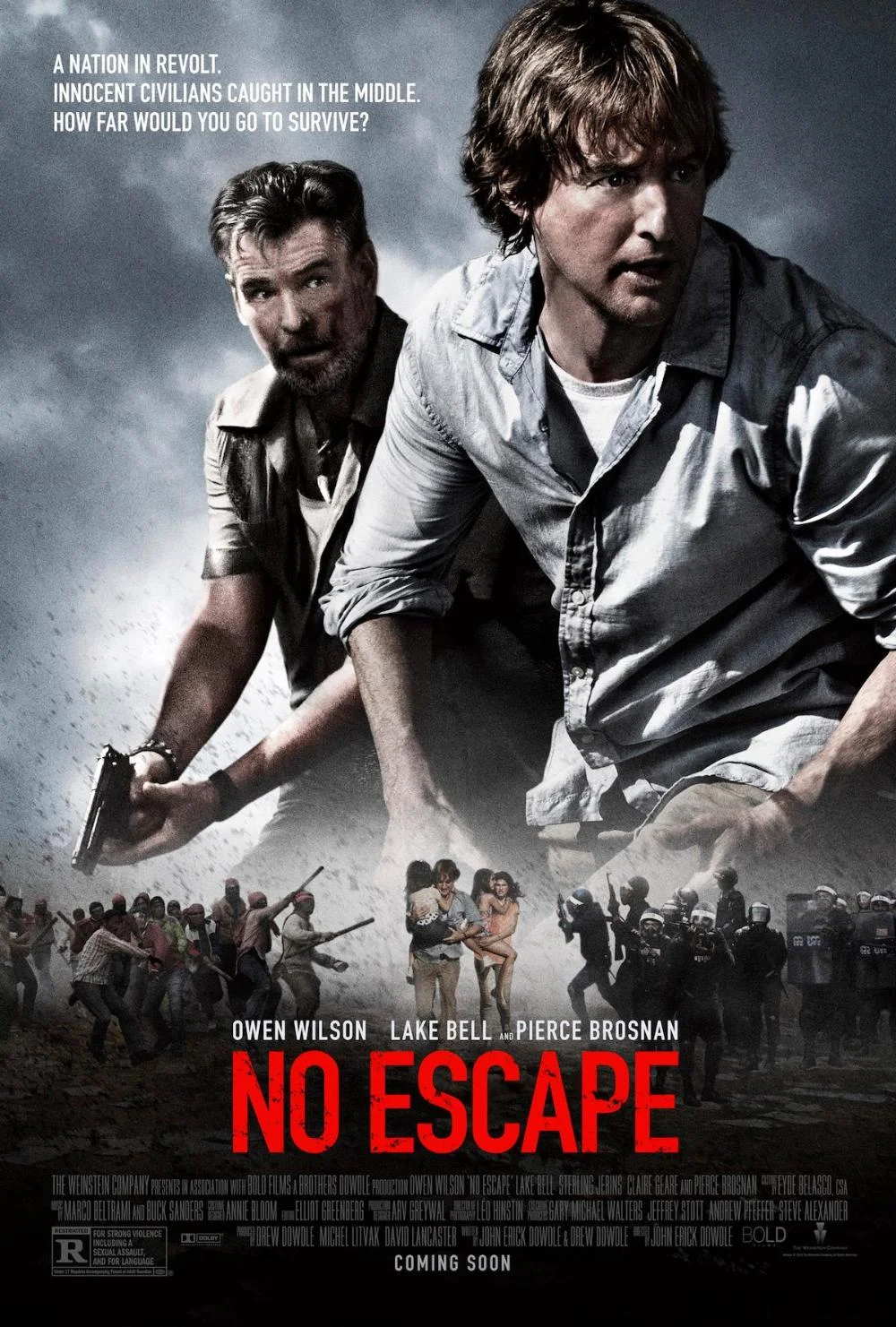
Summer blockbuster season is winding down. There have been some major misses: Fantastic Four, Tomorrowland, Aloha; we’ve seen major hits: Jurassic World, Mad Max: Fury Road, The Avengers: Age of Ultron. For moviegoers, summer premieres offer up a buffet of adrenaline driven plots and extreme visuals. Maybe it’s the hazy heat of August, but this reviewer thinks No Escape could be the cinematic thrill ride needed to cap off your list of hits this season.
No Escape, which stars the sometimes serious — almost always funny — Owen Wilson and Lake Bell, follows the Dwyer family as they attempt at a fresh start. Jack Dwyer (Owen Wilson) has been offered a job with Cardiff, an engineering company that specializes in water treatment facilities. With one failed business behind him, Jack is desperate for this Cardiff opportunity, even though it means uprooting his family and moving them from Texas to Asia. Unbeknownst to the Dwyers, the never-named Asian country is now under the control of a violent group of rebels after the assassination of its prime minister. Stick with me here!
There are many reasons to go to the movies — a chance to see friends, good-looking celebrity leads, the air-conditioning — but the most satisfying reason to see a film is to escape. There is nothing better than leaving the real world at the theater entrance and surrendering yourself to whatever is flashed up on to the big screen. No Escape is not a perfect film, but it delivers enough heart-stopping moments that for an an hour and forty-one minutes, you are simply engrossed.

Those familiar with the trailer of the film know that as the Dwyer family attempts to escape the bloodthirsty rebels they make the unbelievable decision to hurl themselves off of the roof of their hotel, onto the roof of a nearby building. That’s no spoiler, it’s there, right in the trailer! What the trailer does not detail, what you can only get from the watching the film, is just how gut-wrenching the scene is to watch. With their lives at stake, and two young children in tow, this mother and father have to make the decision of a lifetime and as a viewer you cannot help but hold your breath and wait to see where it lands (pun, fully intended). As a viewer, the film continuously forces you to decide what you would do in these adrenaline-pumping moments, bringing you right into the mental space of the Dwyers’ as they run for their lives.

Story-wise, No Escape has some gaping holes. One, the Asian country, where all of this is taking place, is never identified accept to say they’re close to the Vietnam border — a plot detail that would’ve given some more weight to the military coup and made the film less generic. Next, there is Pierce Brosnan, whose character functions as more of a narrative device than an actual person. And finally, there is the film’s final standoff between the Dwyers and the rebels, which is suspiciously calm as compared to the duck-and-cover speed of the rest of the film. These are major mistakes, but this reviewer is willing to forgive them for the breathtaking moments when the film does deliver.
No Escape is a visceral getaway. For those looking for a comparison, the Dwyers’ fight to survive recalled many of the gripping emotions found in The Impossible, from 2012. If you’re willing to forgive some of the film’s letdowns, you’re in for a good time.
Grade: B-
"American Ultra" Review

The psychedelic posters for American Ultra make the film’s purpose clear: it’s a bold, stoner comedy. The film’s tagline — “Everyone’s getting smoked” — further drives the point home. Unfortunately, like most potheads, American Ultra fails to deliver on its promise.
Mike Howell (Jesse Eisenberg) is a stoner with an ambition problem. He wants something beyond the life he has created in the small West Virginian town he lives in. Unfortunately, he’s all too content working at the local convenient store, getting high while doing so, and coming home to his all too understanding girlfriend Phoebe (Kristen Stewart). Things begin to shift for Mike when a federal agent (played by Connie Britton) comes to visit him at the convenient store one night. Through a string of nonsensical words, the agent activates a deadly night of gun-slinging, bomb-blasting debauchery for Mike and Phoebe — just your normal stoner comedy, right?

Comedy is by far one of the hardest genres when it comes to telling a good story. When the main purpose of a film is to get a good laugh, major details like structure and plot can get lost in the name of going for the joke. For American Ultra, the comedy seems to have been prioritized and the all important question of “What is at stake?” is simply forgotten. Between the rushed introduction of the “romantic” leads and the disjointed CIA storyline, there is no space for the audience to get to know these characters or give us a reason to care about them. This set-up worked in the sense that the film is just bizarre enough to be funny, but the humor is one-note, rarely going beyond a well-written line or two. The surface level humor of American Ultra is further compounded by the sheer violence of the film. Guns were a plenty, as were other cringe-worthy kills brought about by dust pans and spoons. Yes, spoons.
A case could be made that this was simply a wrong person, wrong film situation, but as a big believer in comedy, this reviewer stands by the sour taste left in her mouth by American Ultra. There is also the chance that maybe, just like it’s main characters, American Ultra is best watched while stoned. Maybe then this peculiar film would make a little more sense.
Grade: D+
"Mistress America" Review

There is something very necessary about portraying the female experience in all its varying forms. It is a story often left behind — or at least out of focus. Mistress America — directed by Noah Baumbach and cowritten with Greta Gerwig — is a unique approach to the complicated relationships that enrich and detract from being a girl in this world. And no, this isn’t about a boy.
Tracy (Lola Kirke) is the Barnard babe we all wish we were when we started our freshman year at college. She is intelligent, knows how to rock a blazer and her literary aspirations are classically indie. There is one tiny problem though: she does not fit in, or at least her peers seem to have little interest in letting her join in on the freshmen fun. Tracy laments to her mother about her lonely days and nights on campus and her mother reminds her to get in touch with Brooke (Greta Gerwig), her soon-to-be step sister.
Brooke is the thirty-flirty-and-thriving NYC woman, hitting all of the benchmarks of a fabulous New York City lifestyle. At first glance, she does not seem to be the answer to Tracy’s dashed college dreams, but in girl world, the solution to the problem is not about finding the perfect solution — it’s about finding the best solution for right now. Fans of Gerwig’s character from Frances Ha may find Brooke a little grating. She’s manic and blissfully unaware of her shallowness. For Tracy though, Brooke offers up the fun and sophistication that has been lacking from her college experience. They are an immediate pair, informed by Gerwig and Kirke’s obvious chemistry.
Mistress America could’ve easily turned into a self-aware commentary on this generation and the plight of the aimless twenty-something. Instead, the film becomes a situational comedy featuring quick-witted characters who offer a plethora of depth depending on the life experience of the audience member. By stepping away from the will-the-girl-get-the-boy formula, Baumbach and Gerwig have created a film about the other, if not more important, relationships that come in and out of a girl’s life. This film is about the positive and negative experiences we all go through as we chose who to align ourselves with — how you find yourself through the good and the bad.
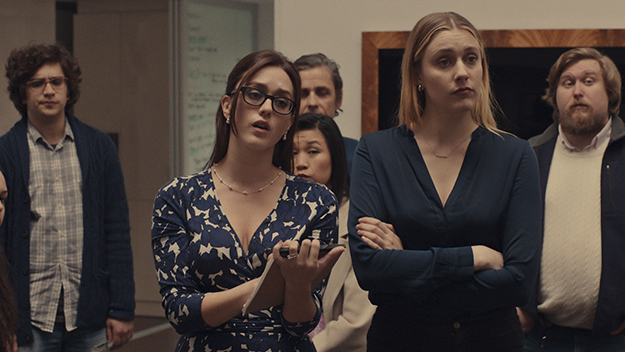
Baumbach and Gerwig clearly know how to get things done. Speaking after the screening I saw, Gerwig noted that Mistress was shot in only 60 days — an extended vacation compared to the 50 days the pair used to shoot Francis Ha. Baumbach and Gerwig also know how to use their time to tell a story that is often not told. Combining an 80s touch and feel (especially apparent in the soundtrack) with quick dialogue, Mistress America offers up the charm, quirk and depth of your favorite short story.
Rating: B
Mistress America releases this weekend in select theaters!
"Dark Places" Review

When a book becomes a movie there is always one main question: how will it compare? For Dark Places, there is a second, more challenging question: how does it compare to Gone Girl? Fans of Gillian Flynn have most likely read all three of the author’s spectacular books: Dark Places, Gone Girl and Sharp Objects. As an author, Flynn weaves tales of women facing a grim (often self-imposed) challenge. There are consistent themes throughout all three of her novels, creating quite the challenge for turning these books into movies, especially with Gone Girl’s critical success.
Dark Places is intentionally disorienting as the pieces of Libby Day’s past and present are brought to screen. Between grainy flashbacks, we meet current day Libby as she grapples with a dismal financial future. We learn that she has been living off donations from strangers who want to show their support after the gruesome murder of her mother and two sisters. Libby and her brother Ben survived that night — although Ben has spent many years locked away after being charged with the murders. Faced with a shrinking bank account (and no job to speak of) Libby turns to the Kill Club, a gathering of murder super fans, who are willing to shell out $500 bucks for her to make an appearance at their latest gathering. Much to Libby’s dismay, the Kill Club is not just a group of fans, they are vigilantes — hoping to prove that her brother Ben was wrongly accused of the murders. Libby’s financial motivation, coupled with the persistence of the Kill Club, get the story going and takes the audience back and forth in order to figure out who really killed the Day family.

There is no doubt about it, the cast for Dark Places is stacked. Libby’s mother is played by Mad Men’s Christina Hendricks, the treasurer of the Kill Club is played by X-Men’s Nicholas Hoult and Drea de Matteo even makes an appearance as old classmate turned stripper. By and far, the most notable performance is delivered by Chloe Grace Moretz, who plays a teenage love interest of Ben’s. Moretz is a fiery scene stealer and this reviewer wishes the whole film was based around her character, Diondra. Charlize Theron plays present day Libby Day and delivers a “dark” performance, but at times she simply tries too hard. Moretz pulls off enigmatic Diondra naturally, in a rather frightening way.
Although Dark Places sprang from the same mind of Gone Girl, the two films simply do not compare. While Gone Girl takes on Flynn’s twisted tale with a cool and crisp approach, Dark Places feels clunky and all too aware of its purpose. Director Gilles Paquet-Brenner’s jerky camera movements and approach to the film’s major themes feel forced, put in as part of a checklist rather than as an artistic statement. Separating it from its Gone Girl counterpart, Dark Places does function as a somewhat thrilling, more decadent episode of Law and Order: SVU, which is always worth a watch.
Rating: B-