
"Fatale" Review: What Happened In Vegas, Didn't Stay There!
“Fatale” is the latest in the cheating husband who messed with the wrong woman genre. “Fatal Attraction” is the gold standard for husbands stepping out on their wives and reaping what they sow. Since the 1987 film there have been plenty that have tried to emulate it or deliver something similar. In fact, screenwriter David Loughery wrote 2009’s “Obsessed”, which had a similar theme. It seems he learned a few things with his latest screenplay for “Fatale” by side-stepping predictability but a couple flaws keep it from greatness.

Derrick (Michael Ealy) is a man who has it all on paper. He’s got the job, the luxurious house, and a beautiful wife. He and his wife have hit a rough patch and they seem to be on different pages. So when Derrick attends a bachelor party in Vegas with his business partner Rafe (Mike Colter), he has a one night stand with Val (Hilary Swank). It’s a mutual fling with both stating they are from out of town trying to blow off steam.
The next morning, Derrick wakes up and is ready to bounce, having come to his senses, but Val wants more. Weeks later, Derrick has the fight of his life with a masked home invader. When the police arrive, the detective in charge of the case is Valerie Quinlan, his one night stand. From there, the game of cat and mouse begins with some surprising twists along the way.

Swank has fun trying on a non-traditional character for her. She walks the tightrope of a scorned woman and an evil genius with just the right touch of humanity to create a three dimensional fatale. Ealy brings a certain relatability to his fish out of water character and does what he can with the script. Unfortunately, his character is written to continuously make poor decisions. That doesn’t stop him and Swank from having some juicy moments on screen. The subtext in their second encounter, right after the home invasion, is fun to watch. In fact, a lot of the delivery of Swank’s lines have a consistent weight to them that makes her character scary yet thrilling to watch because she’s so smooth with her hidden rage.
A lot of credit goes to director Deon Taylor. He’s shown tremendous growth in his storytelling since he dipped his toes in the thriller genre with "Traffik". He understands how to craft suspense (as evident in his last pairing with Ealy in "The Intruder") and uses his camera to speak where the script doesn’t. In one scene, after speaking with Derrick, Val backs out of the driveway with the camera locked down and watching from the back seat. As the car goes up the natural incline of the driveway and then levels out, Derrick disappears from the background of the frame due to the front of the car lifting up. We’re left to focus solely on Val’s face in the foreground. It’s a power shift that is told in pictures, not words. Taylor is certainly one to watch.
Cinematographer Dante Spinotti shoots LA for the first time since “Heat”. It’s a gorgeous and sleek looking film that adds to the story that all that shimmers isn’t gold. This is the third collaboration of Taylor and Spinotti and each outing continues to build on their ability to tell story through film.
While the “Fatale” does a good job of subverting the stereotypical plot, it forgets to leave the dumb husband trope out of loop. By the time Derrick starts making good decisions, you’ve yelled at the screen enough to leave him to Val’s schemes. Nonetheless, it’s still an entertaining watch with some moments you won’t see coming.
Rating: B
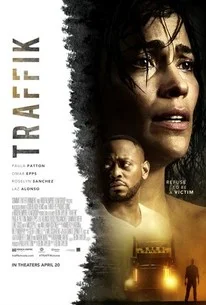
"Traffik" Review
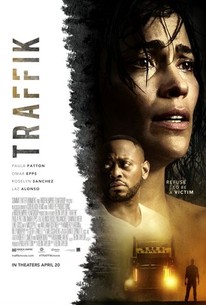
Refuse to become a victim. That’s the tagline of Deon Taylor’s new film Traffik. You ever feel like you’ve been okey doked? There’s a lot of weight in that tagline. It screams survival, defiance, fight. Yet, the film is the definition of a slow burn thriller. Once the film takes off, it’s a fun ride, but it takes far too long to get there.
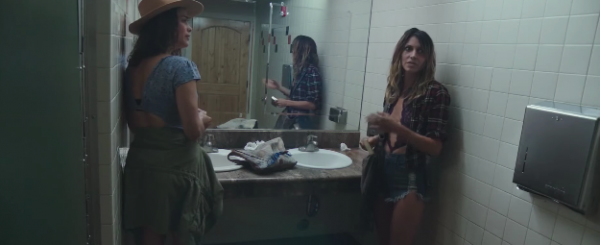
Brea (Paula Patton) and John (Omar Epps) decide to get away for the weekend by going to John’s buddy Darren’s (Laz Alonso) vacation home in the secluded northern California mountains. On the way up, the couple has an unpleasant interaction with a racist biker gang when they stop at the local gas station. While John has a verbal and physical exchange with one of the bikers outside, Brea unbeknownst to her, receives a phone from Cara (Dawn Olivieri), a woman who appears to be in danger with her biker boyfriend, in the restroom.
While the exchange in the restroom didn’t send off a red flag in Brea’s mind. It finally goes off once the phone starts ringing later that night. Now joined by Darren and his girlfriend Malia (Roselyn Sanchez) at the house, the foursome unlock the phone to discover a secret that could cost them their lives. Especially, when the bikers come looking for their phone.
The biggest issue with the film is that it takes almost half of its running time to get started. There is a lot of exposition in the beginning. Characters establish how wonderful another character is or isn’t through lengthy dialogue. Brea and John stop randomly on the ride up the mountain to make love in the car John built from the ground up as a birthday present for Brea. Brea debates and compares notes with Malia whether she wants to take the next step with a man who seems to be proving himself at every turn. It’s these random pit stops in the script’s attempt to verbally over-talk us into caring along the way to the big event that detract from the story.
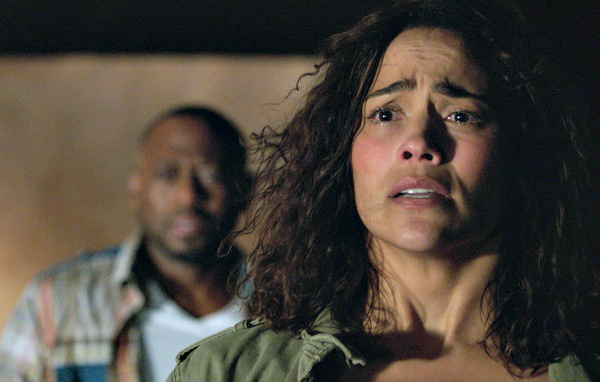
However, once the biker gang comes to retrieve their phone, the film really takes off. Cinematographer Dante Spinotti paints the first half of the film with a glamorous hue, and switches to limited, natural lighting when it’s time for the characters to survive. Scenes are lit by headlights, or lamps in a home. The lighting really pulls you in to the intensity and solitude being exhibited in the film. Taylor has a way of building the suspense in the film visually by establishing the space of locations and then using the frame as a peak into what’s happening.
The performances in the film are serviceable but certainly not memorable. While the film’s title alludes to human trafficking, it touches on it, but feels more like it’s using it as a background plot device within the film. Which leads me to my opening point in that the film doesn’t really give what it’s selling.
I ultimately enjoyed the survival portion of the film. This is the type of film that you want to see with someone else so that you can yell at the screen and tell Brea and John what to do. It’s the type of film that you lean over to your spouse and say “make sure you shoot to kill if we’re ever in a situation like this.” It’s the type of film that will give you 96 minutes of escapism while viewing, and you’ll forget about it next week. Know what you’re getting into when you enter and you’ll have a good time at the movies.
Rating: C+