Tribeca Film Festival '16: "Live Cargo" Review
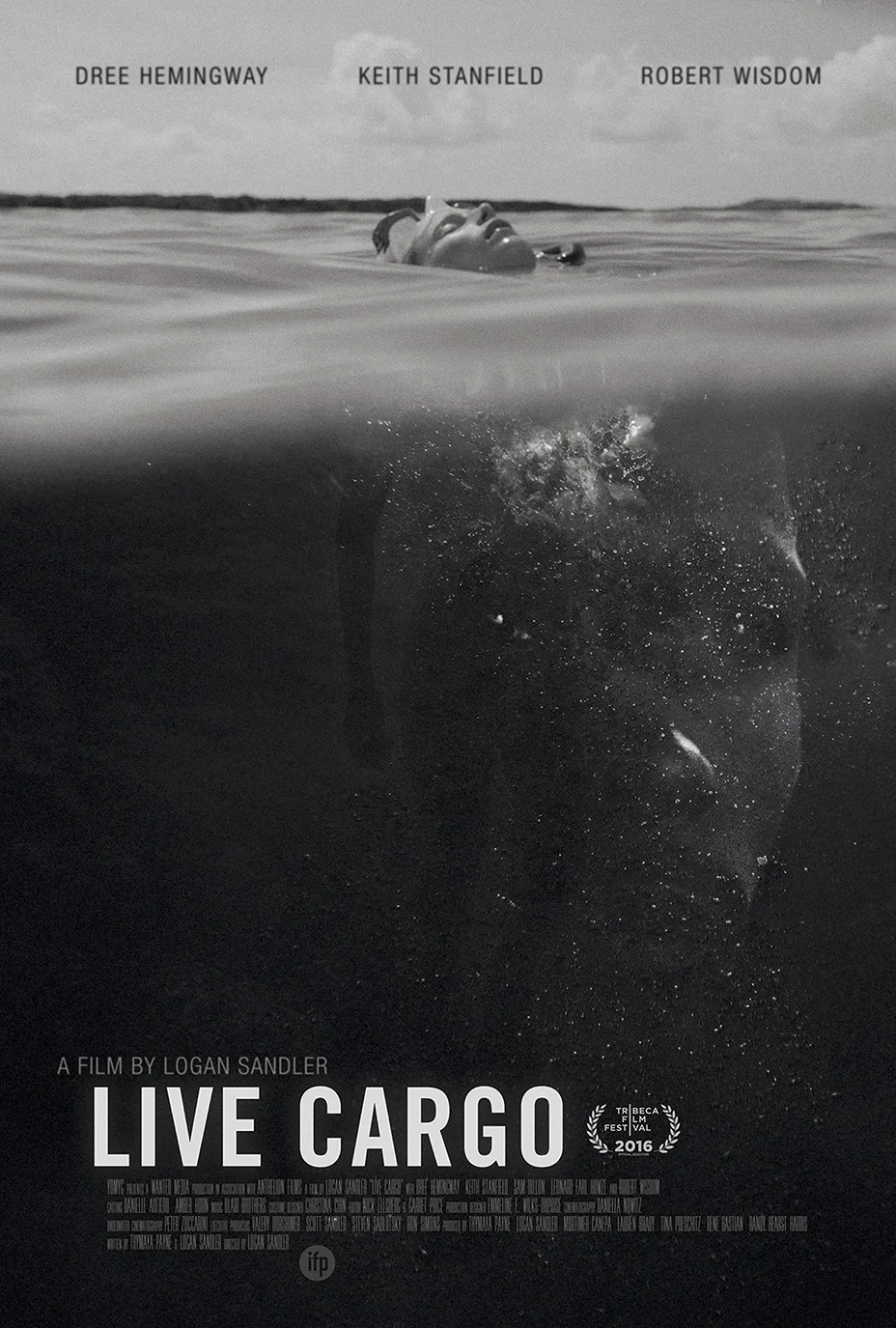
Out of the films I saw at Tribeca this year, one that sticks with me is Live Cargo. It could be the beautiful black and white cinematography. It could be the unconventional storytelling. Or maybe it was the moving performances and skilled direction. Out of the number of reasons that the movie still haunts my film nerd dreams, the number one reason is because I left it feeling like I partook in a refreshing cinematic experience that was as pure and passionate as something from a graduate thesis film but technically proficient enough to study and dissect in the same class!
In the film, we find Nadine (Dree Hemingway) and Lewis (Keith Stanfield) at one of the lowest points of their married life. They’re sitting in a hospital room, noticeably apart, while Nadine holds her newborn baby’s corpse in her arms. The black and white film emphasizes the moment even more, stripped of its color, just like the couple’s world has been. In order to escape and heal, they go to the Bahamas. It’s where Nadine grew up vacationing and learned to dive with Roy (Robert Wisdom), the guy that knows everyone and is the self-described policeman of the island.
Upon arriving they meet Myron (Sam Dillon) who is on the boat helping Roy for the day. Myron is a young man who was abandoned on the island by his parents. He knows the island, he knows how to survive, and he knows he wants Nadine. He survives by working for the major boatmen of the island, Roy and Doughboy (Leonard Earl Howze).
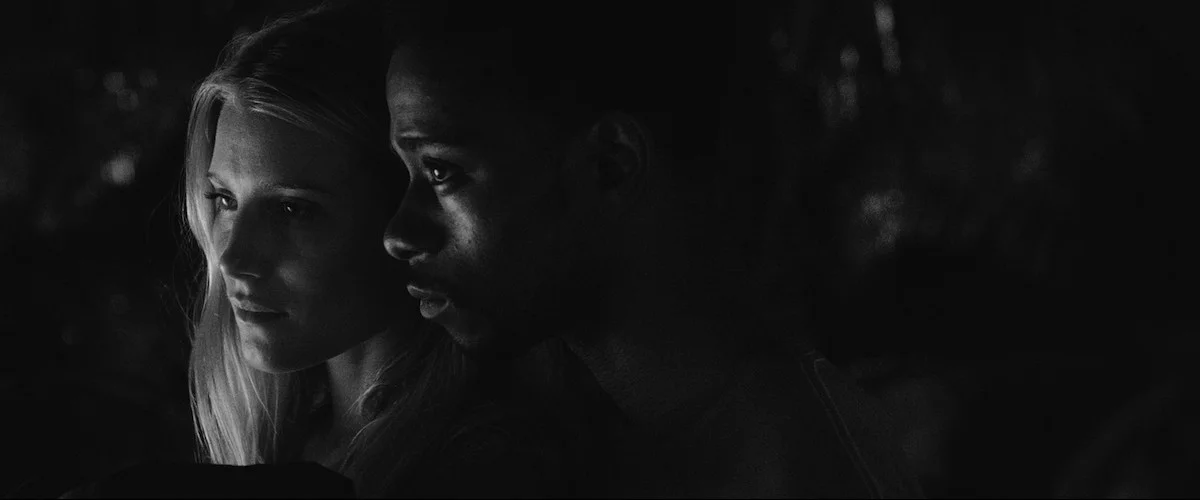
As the film moves forward we witness Nadine and Lewis as they deal with their loss. They’re like similar ends of magnets; attempts at coming back together are thwarted by the ordeal. Yet a slowly brewing turf war on the island just might be what they need to bring them together.
They say a picture is worth a thousand words. Cinematographer Daniella Nowitz captures gorgeous frames worthy of a print ad at times, while using the black and white to simultaneously catch tones and textures we wouldn’t usually notice. The sweat seeping through a shirt, or glistening off of someone’s forehead stresses the heat of the island and the work of the islanders. The lack of color itself, in a place where we would expect to see stunning hues, forces your focus on the story while enhancing the way you take it in.
Director Logan Wyatt allows the images to speak more than his actors at times (and their performances are wonderful). How do you put loss into words? What’s the cost of a life? Wyatt explores these questions by letting his actors be in the moment and cutting the film together in such a way that his audience can contemplate and draw conclusions. Having grown up partially in the Bahamas, his intimate knowledge of island life shines through by acknowledging the beauty of it while not exploiting it like a Sandals commercial.
The cast has the right blend of magic. Veteran Robert Wisdom is a driving force as the patriarch of the island, while Howze brings an underlying jaded ambition to his character. Hemingway, Stanfield, and Dillon give natural, nuanced performances that make for an intense triangle with tension slowly building beneath every interaction.
There is no question that Live Cargo may not appeal to some, because of its unique narrative and shooting style. It’s a mood piece that works visually and aurally to evoke emotion while telling its story. If you go with it, there’s no doubt in my mind that it will stand out in yours as well!
Rating: A
Check out my interviews with the cast and crew:
"Until 20" Review

Childhood cancer is one of those topics that I believe we don’t want to address as a society. Numbers don’t lie; only 4% of the budget of the National Cancer Institute goes to pediatric cancer research. As long as it doesn’t affect us personally, by those numbers, sadly it seems we’d rather keep living our lives with no regard to the issue, myself included. Perhaps it’s because we’d be faced with our own mortality, our children’s, or because to be honest, it’s somber. So when it comes to a movie, why would you want to watch one about childhood cancer? Keep reading and I’ll tell you!
James Ragan was diagnosed with bone cancer at age 13. When we first meet him, he’s bald, skinny from treatments, and way stronger than most of us. He’s viewing the latest results from a scan with his doctor and family. He tells the doctor that he’d like to “preserve a little bit of quality for when we’ve sorta kicked the can as far as we can kick it so to speak.” It’s this statement and James’ strength in the face of a doctor telling him that without further treatment he has six months to live- within the first five minutes of the film- that engages you to want to see and learn more about James and his journey.

What “Until 20” provides is a pure look into a young man and his family’s life as they’re going through it. There’s no doubt that when the film picks up James has already been through the fire, and his strength and resolve to help other pediatric cancer patients is inspiring. James created the Triumph Over Kid Cancer Foundation in 2007 as a way to raise money and awareness to the cause. Throughout the film it’s obvious that because life isn’t promised to him, he lives his to the fullest, enriching and encouraging the lives of those around him.

Typically in a film like this you expect to focus on how awesome the main character is, and hear from people who will testify to it. While that is a part of the film, you slowly get to know the people surrounding James, pulling you into his family and village of loved ones. Whether it’s his mother Gloria, who is trying to keep it together and be there for her son, while simultaneously missing out on being present for her daughter because of it. Or his sister Mecklin, who loves her brother with all her heart, and yet sacrifices attention and love from her parents at times because her brother needs it more. The doctor, who has to tell James (and one would assume other cancer patients) the bad news, while also viewing him as someone that he hopes his sons will grow up to be like. The list goes on, but the evidence of how cancer’s effects ripple out to those surrounding James is apparent. Yet, a constant sense of love and resilience comes through in every frame. That’s what makes the film powerful.

Another thing that stands out about “Until 20” is the stylistic shot choices and poetic technical nature of the film. One would usually expect a film of this theme to be run and gun, with not much thought into the shooting style outside of capturing the events. While a couple of times the style choice feels a little too much (some scenes in which an interviewee is emotional and the camera continues to dolly side to side), it is aesthetically beautiful. The time and care given to the film by directors Geraldine Moriba-Meadows and Jamila Paksima is evident in the film’s construction from production value to the way the story is laid out. As I watched, I couldn’t help but feel like the Ragan family came together and agreed to tell their story, unfiltered, as a unit, and that James wanted to document his journey for the world to see. Faced with that responsibility, Meadows and Paksima stepped up to the plate and hit a home run.
Sitting through “Until 20” is in no way a walk in the park. It’s unsettling at times, causes you to put your own life in proper perspective, and has its Kleenex moments. Grounded in the reality of life, the film puts a face to childhood cancer and allows you to experience the love, trials, and pain that a family affected by cancer must endure. At the same time it’s uplifting and beautiful! It's cliche to say, but the film is truly more about living your life and embracing each moment. The love that the Ragan family has for one another is undeniable. I couldn’t help but think that the film is exactly what James wanted. While our lives are but a mist, film is forever, and with this film his message lives on and speaks to the heart of a viewer in ways that a speech never could! Hopefully with this film, one family’s loss is the world’s gain, as it inspires us to get involved in some small or large way.
You can learn more at http://triumphoverkidcancer.org/.
Visit http://until20.com/ to find out more about the film and future screenings.
Rating: A+
Our City Festival '15: "Out of the Basement"

“Out of the Basement” is the indie film that you want to stumble upon at a film festival. Directed by Natalie Avery and Kyle Joseph Centers, the film on the surface is an American Dream, underdog story. In reality, it’s a well constructed story about family bonds and how love can push you to accomplish your dreams or help see others accomplish their own.
We’re introduced to Greg Newby, a DC native and amateur boxer who wants to go pro. He works at his grandfather’s corner store while training. His goal is to use boxing to help himself become financially stable and perhaps financially independent in order to take care of his daughter. As we get to know Greg and see him hard at work, we also learn about his past and how it affects his present.

The key to the film is the relationship between the directors and Greg’s family. It’s obvious that the family trusted the directors, and therefore were honest and open with their lives. Greg’s father talks about his struggle to raise Greg. Greg’s grandmother talks about the fact that someone has always been in his corner, and how she thinks that affects his work ethic. It’s the honest moments in this short film that make it intimate and engaging. The construction of the short doc is smooth, seamless, and welcomes you in to the lives of the tight knit family with pro boxing dreams.
If you’re looking for an entertaining, character driven short that packs a punch than check out “Out of the Basement”. The film plays during the OUR HEART film screening at the Our City Festival this Saturday, June 7th at the Goethe Institut.
Tribeca Film Festival '15: "Cronies" Review

If “Friday” met “Baby Boy” on a blind date to see “Boyz In the Hood”, the resulting love child would be “Cronies”. As complicated as that equation is, it perfectly sums up the influences and themes the film explores like friendship, loyalty, personal evolution, not letting the past define you, and masculinity. Executive produced by Spike Lee, “Cronies” is the second feature length film from Michael Larnell and likely won’t be the last.
The low budget film is shot in black and white, and uses color to highlight major events much like “She’s Gotta Have It”. Covering the course of a day in St. Louis, the film starts at the home of Louis (George Sample III). Louis is trying to get on the good foot after making a promise to his girlfriend. They are raising a daughter together, and plan to celebrate her birthday the next day. Jack (Zurich Buckner) is Louis’s uncouth, hot headed, live-wire friend. It’s obvious that they were probably best friends at a point, but it’s not quite clear what is dividing their relationship in the beginning of the film.
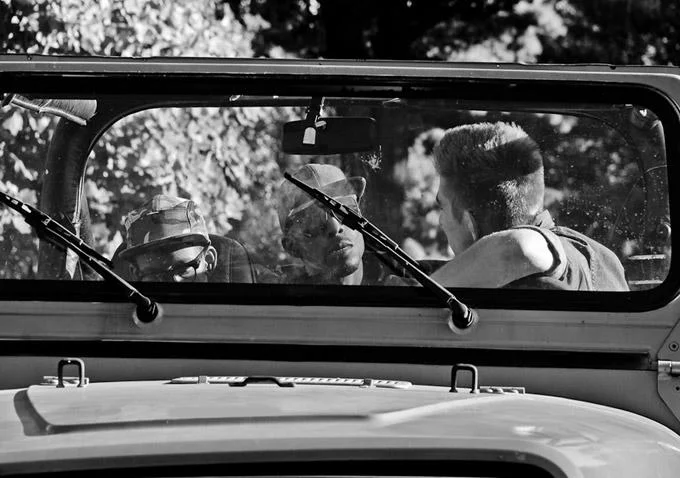
Andrew (Brian Kowalski) is Louis’s stiff, white co-worker from the local car dealership. When Andrew stops by to hang out with Louis, Jack takes it upon himself to inquire as to why. From there, Jack becomes the third wheel as he pushes his way into Louis and Andrew’s activities for the day. It’s an uncomfortable ride as Jack grills Andrew with questions like a jealous ex-girlfriend. Perhaps Jack feels that Louis is moving on in their friendship, and he doesn’t want to be left behind. Regardless, Andrew keeps his cool and stays on Jack’s good side, while Louis barely talks at all.
As the day goes on, Andrew slowly wins favor and a mutual tolerance with Jack. It could be the half naked girl, high on ecstasy, who swims in the pool at Andrew’s friend’s house. It could be because Andrew isn’t afraid to “holla” at random chicks Jack points out. It could be because “Andy” (as Jack calls him) keeps giving him squares (cigarettes) and let’s him smoke his weed when he asks. In all these instances Jack asserts his masculinity for the world to see. It’s in these moments that Larnell examines the perception of masculinity. Whether and how you rise to the occasion seems to define the trios level of manhood and perhaps establish the alpha in the group.
Each character hides behind a costume. Whether it’s Louis’s glasses, Jack’s shades and hat, or Andrew’s clean cut look, everyone uses their exterior wardrobe to shield themselves. It’s something we all do. It’s in Larnell’s one on one, man on the street interviews that their shields are set aside and their true identity is pierced by Larnell’s searing questions. In one scene, Larnell asks Louis if he’s in love with his girlfriend. It takes him a while to admit it and he finally concedes but not without a coinciding statement that asserts he’s not soft. Jack actually takes has his sunglasses off while answering a question. The man on the street interviews serve as story building emotional beats that work.
By the next day, the trio has been through enough to continue their friendship, proving that experiences build relationships. Louis and Jack have squashed their beef, and Andrew is a part of the family. The guys have matured just a little bit and regardless of if they continue to evolve as men, for the moment, they have.
Rating: B-
Tribeca Film Festival '15: "Stranded in Canton" Review
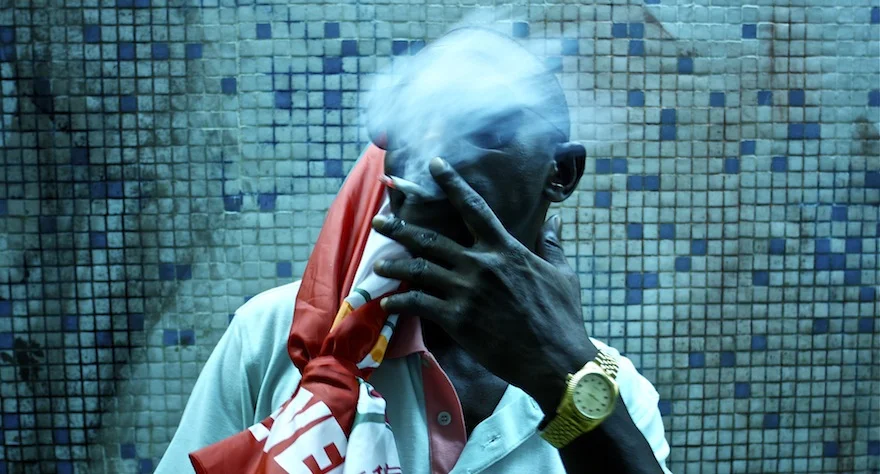
Photo Courtesy of Tribeca Film Festival
Independent cinema allows us to be presented with characters who are typically underrepresented on the big screen. With “Stranded in Canton”, writer/director Mans Mansson gives us an interesting character study in Lebrun (Isibango Iko Lebrun), a Congolese farmer whose dreams for a better life both propel him forward and blind him simultaneously.
Lebrun is a wanna be entrepreneur who believes every excuse that comes out of his mouth and hopes you will too. In fact, he’s counting on it. His most recent endeavor finds him stranded in China after ordering a large amount of t-shirts for the election back home in the Democratic Republic of Congo. Unfortunately, he receives them after the election has passed and with boxes full of shirts that say vote for a president who can not run for office again, Lebrun has to figure out a plan B.
Lebrun doesn’t have much time to figure things out. Wassim (Wassim Hasbini), an overweight storage space owner who rides a moped to travel a few yards away, wants the money he’s owed for holding the t-shirts in storage. The Chinese want the money for making the t-shirts, and Lebrun makes calls to an elder back home who he’s seemed to promise a watch and an engine at least. As the movie continues it becomes more apparent that Lebrun doesn’t really have a plan, and may not have had one when he ordered his shirts, outside of selling them for a profit.
Sylvie (Sylvie N’Dya) is a fellow African living in China, and the one person who takes the time to listen to Lebrun and give him advice. She has her own shop and the wisdom that comes along with it. Yet when she tells Lebrun the truth about his shirts (possible failure), he continues to push forward off of his half-baked idea to make money with an eerie sense of calm and a desire to prove his worth as a businessman.
Mansson has complete control of the direction of the film. He uses pacing and extreme close ups as tools, forcing us to focus on what he wants. In a film in which so many different languages are spoken, he understands that sometimes the eyes convey what the lips are saying. While the film is subtitled, its visuals speak volumes. He let’s moments within the film play out to the point of exhaustion in a way that feels more like a documentary than a fictional narrative.
While we’re left with a real look at what an unskilled businessman looks like, the film spends too much time in the same position. There are not many new developments in plot, nor a major conflict. Everyone wants their money, but there’s not a real threat to Lebrun to give it to them. While the film does raise questions of politics and what success is, it struggles to bring it all together. Like Lebrun, “Stranded in Canton” is a great idea running off fumes rather than cinematic fuel.
Rating: C
Now playing: https://tribecafilm.com/filmguide/stranded-in-canton-2015
Tribeca Film Festival '15: "Cafe Glass" Review

As the internet and social media continues to expand, writer/director Wen Ren paints a future where online dating is the social norm. People walk around with “wearables” (technology that you wear like glasses) that give you automatic access to the internet. Users are alerted when another user is checking them out, and they can reject their virtual advances on the spot. The film’s CG work does the heavy lifting to make this world a reality as it’s main character, Zayn (Devin Goodsell), visits the local cafe to sit with his friends.
As the cafe loses internet connection, the entire patronage is in an uproar as they have to come face to face with one another with no online connection. Zayn is then forced to make a decision as to whether to take his most recent encounter offline. While “Cafe Glass” may be a comedy, it stirs up serious questions for what seems like a not too distant future. As we exchange personal connections for virtual ones, what does that mean for future generations? Are social skills morphing or declining? “Cafe Glass” is sure to give you a couple laughs, but it will equally give you something to chew on.
Now playing: https://tribecafilm.com/filmguide/cafe-glass-2015
Tribeca Film Festival '15: "Catwalk" Review

Photo Courtesy Tribeca Film Festival
Much like it’s title, “Catwalk”, is an exploration of the fine line between parenting and allowing your child to find his or herself amidst peer pressure. Ella (Freddie Mosten-Jacob) is nine, an impressionable age, and her classmates are interested in labels, selfies, and fashion blogs. Ella desires to break out of the world of glittery shirts and other “ugly” clothes that she currently wears in order to fit in.
Most of the film is from the perspective of Ella. Freddie’s performance is natural and personal, allowing the audience to remember when they were at her crossroads or dealing with their own child's journey to adolescents. Writer/director Ninja Thyberg presents a well rounded, universal story that makes you think from both sides of the coin as to how to build a child’s confidence. With a pulsing score, and great performances, "Catwalk" is a short to see!
Now playing: https://tribecafilm.com/filmguide/catwalk-2015