
Tribeca 2019: "East of The River" Review

Not every life is a fairy tale, but every life has moments of levity, beauty, and love that can be found in them. East of The River is a day in the life film about a young girl who doesn’t seem to have the best life, but she’s making the best of it. Teonna (Ayiana T. Davis) is unexpectedly suspended from school. After trying to find out why and getting no answer, the only question she has is if she can still get breakfast. Suspended and forced to hit the streets, Teonna links up with her friend Malik (Malachi Mack) who seems to ditch school often. They find Sara (Steloni Mason), who has given up school completely for money opportunities in the streets.

Sara takes Teonna and Malik on an adventure through Washington, DC and east of the Anacostia River. Teonna’s admiration of the older, seemingly more sophisticated Sara is seen through lingering shots of Teonna’s eyeline gazing up at her. Director Hannah Peterson has certainly picked up a few things after serving as a production assistant for Shawn Baker’s The Florida Project. Her use of first time actors to tell this story makes it soaked with authenticity. Peterson’s constraint in allowing a scene to breathe and take shape permits the audience to live in the moment with this group of teenagers. They may not make the most ethical decisions, they’re the kids you wish would be quiet and sit down on the metro, but this is life for them. These are the cards they’ve been dealt and this is how they deal with it.
East of The River is a short that could very well be turned into a feature down the line. Its characters are fully developed and interesting to watch. If nothing else, it’s a good reminder that you can find beauty in the little things of life, and sometimes that gratitude can overcome your surroundings.
"Until 20" Review

Childhood cancer is one of those topics that I believe we don’t want to address as a society. Numbers don’t lie; only 4% of the budget of the National Cancer Institute goes to pediatric cancer research. As long as it doesn’t affect us personally, by those numbers, sadly it seems we’d rather keep living our lives with no regard to the issue, myself included. Perhaps it’s because we’d be faced with our own mortality, our children’s, or because to be honest, it’s somber. So when it comes to a movie, why would you want to watch one about childhood cancer? Keep reading and I’ll tell you!
James Ragan was diagnosed with bone cancer at age 13. When we first meet him, he’s bald, skinny from treatments, and way stronger than most of us. He’s viewing the latest results from a scan with his doctor and family. He tells the doctor that he’d like to “preserve a little bit of quality for when we’ve sorta kicked the can as far as we can kick it so to speak.” It’s this statement and James’ strength in the face of a doctor telling him that without further treatment he has six months to live- within the first five minutes of the film- that engages you to want to see and learn more about James and his journey.

What “Until 20” provides is a pure look into a young man and his family’s life as they’re going through it. There’s no doubt that when the film picks up James has already been through the fire, and his strength and resolve to help other pediatric cancer patients is inspiring. James created the Triumph Over Kid Cancer Foundation in 2007 as a way to raise money and awareness to the cause. Throughout the film it’s obvious that because life isn’t promised to him, he lives his to the fullest, enriching and encouraging the lives of those around him.

Typically in a film like this you expect to focus on how awesome the main character is, and hear from people who will testify to it. While that is a part of the film, you slowly get to know the people surrounding James, pulling you into his family and village of loved ones. Whether it’s his mother Gloria, who is trying to keep it together and be there for her son, while simultaneously missing out on being present for her daughter because of it. Or his sister Mecklin, who loves her brother with all her heart, and yet sacrifices attention and love from her parents at times because her brother needs it more. The doctor, who has to tell James (and one would assume other cancer patients) the bad news, while also viewing him as someone that he hopes his sons will grow up to be like. The list goes on, but the evidence of how cancer’s effects ripple out to those surrounding James is apparent. Yet, a constant sense of love and resilience comes through in every frame. That’s what makes the film powerful.

Another thing that stands out about “Until 20” is the stylistic shot choices and poetic technical nature of the film. One would usually expect a film of this theme to be run and gun, with not much thought into the shooting style outside of capturing the events. While a couple of times the style choice feels a little too much (some scenes in which an interviewee is emotional and the camera continues to dolly side to side), it is aesthetically beautiful. The time and care given to the film by directors Geraldine Moriba-Meadows and Jamila Paksima is evident in the film’s construction from production value to the way the story is laid out. As I watched, I couldn’t help but feel like the Ragan family came together and agreed to tell their story, unfiltered, as a unit, and that James wanted to document his journey for the world to see. Faced with that responsibility, Meadows and Paksima stepped up to the plate and hit a home run.
Sitting through “Until 20” is in no way a walk in the park. It’s unsettling at times, causes you to put your own life in proper perspective, and has its Kleenex moments. Grounded in the reality of life, the film puts a face to childhood cancer and allows you to experience the love, trials, and pain that a family affected by cancer must endure. At the same time it’s uplifting and beautiful! It's cliche to say, but the film is truly more about living your life and embracing each moment. The love that the Ragan family has for one another is undeniable. I couldn’t help but think that the film is exactly what James wanted. While our lives are but a mist, film is forever, and with this film his message lives on and speaks to the heart of a viewer in ways that a speech never could! Hopefully with this film, one family’s loss is the world’s gain, as it inspires us to get involved in some small or large way.
You can learn more at http://triumphoverkidcancer.org/.
Visit http://until20.com/ to find out more about the film and future screenings.
Rating: A+
"The Trouble With The Truth": An Indie Gem
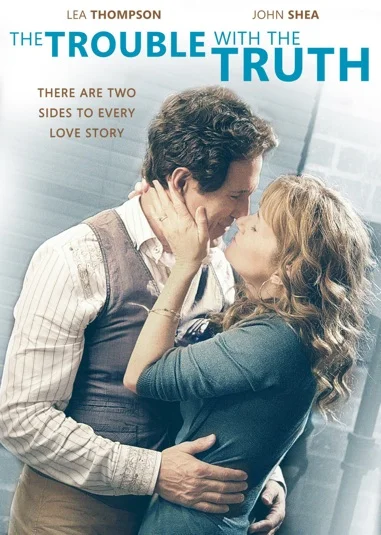
Similar to “My Dinner with Andre” and Linklater’s “Before” trilogy, “The Trouble with The Truth” hinges on a conversation between its main characters. Real time conversational movies are difficult to master because the dialogue and actors who deliver it have to be on point. It lives or dies with both components. Writer/director Jim Hemphill, however, has the perfect storm in this romantic indie drama.
Robert (John Shea) and Emily (Lea Thompson) were married for 14 years before they divorced. Now, their daughter Jenny (Danielle Harris) is engaged to be married and as most marriages do, it brings her parents together. After receiving a call from Robert, Emily agrees to meet him for dinner during her next trip to LA.
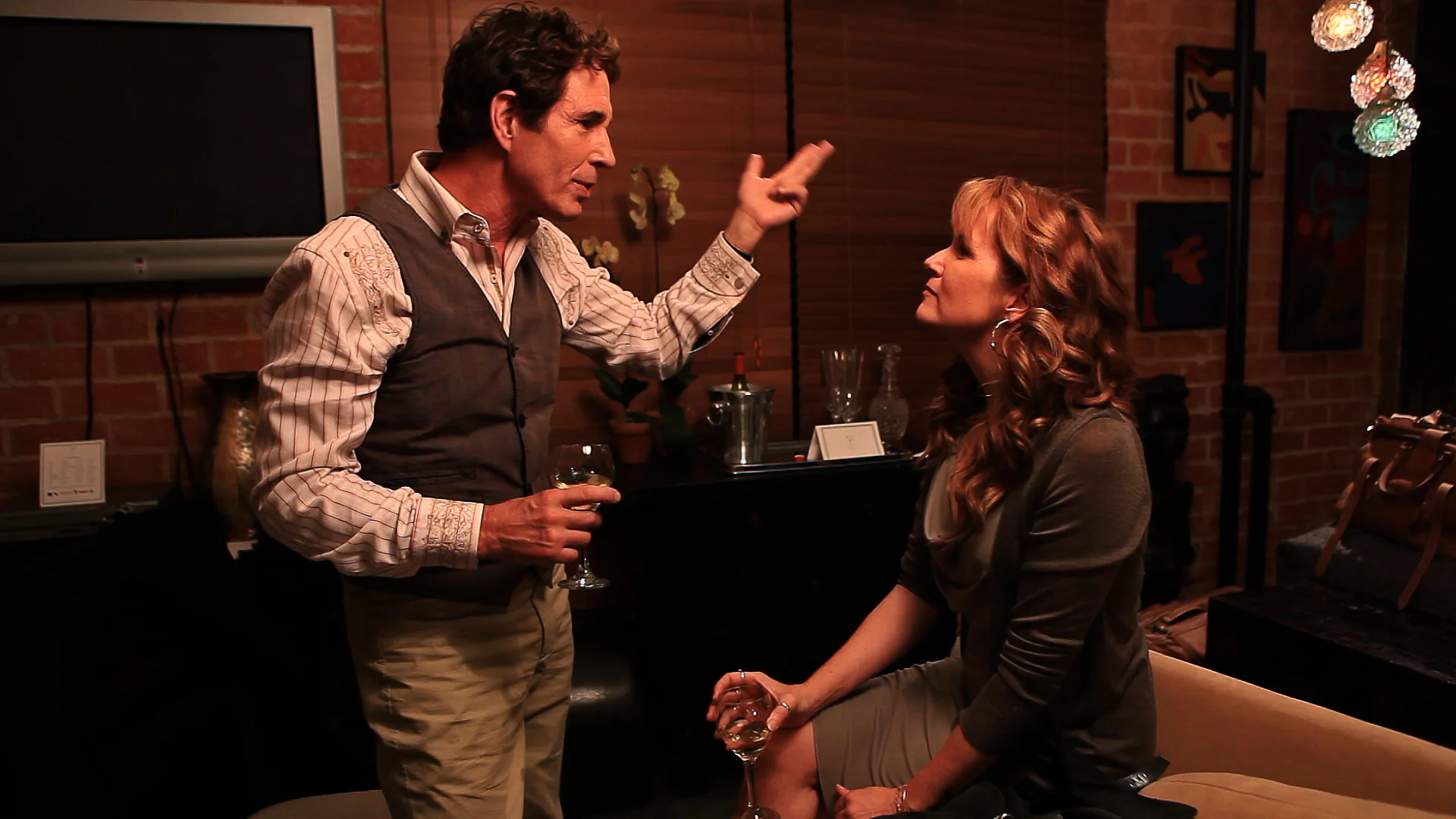
The two make small talk about Emily’s work as a novelist and Robert’s career as a musician at the bar before settling upstairs for dinner. The meat and potatoes (excuse the pun) of the film takes place at the dinner table. The two discuss their relationship, what went wrong, regrets, and their present relationships in one long conversation.
Hemphill’s dialogue is as close to perfect as scripted dialogue can be in a film like this! As the two talk, they dance around what they truly want to say at times and get to the point at others. This game of cat and mouse constantly throws logs and breathes life onto their old flame, building the romance of the drama.
The chemistry between Shea and Thompson is indisputable! As the conversation continues, the underlying attraction between the two grows as well. The simultaneous maturity of the actors (in real life) and character’s (on screen) wisdom spills out into their dialogue and acting nuances, creating a sexy concoction of suspense. Both actors connect with their characters in such a way that makes you want to continue eavesdropping for the rest of the 96 minute film!
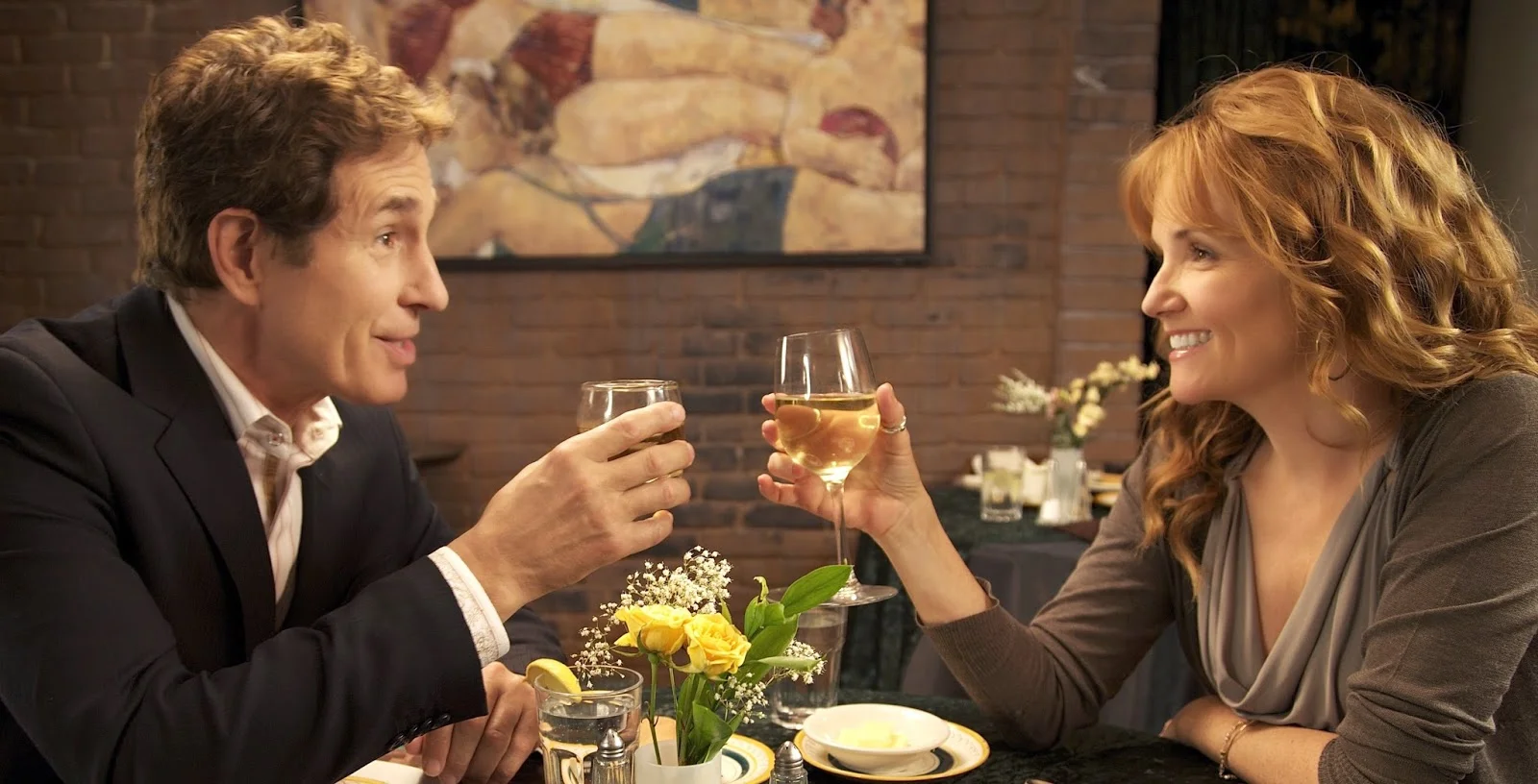
Hemphill’s “Truth” rings true indeed. Every moment feels authentic, and is sprinkled with the right amount of humor to break up the serious tone. The build up to the finish line makes for a satisfying conclusion.The result is a romantic indie drama that’s worth the view and worthy of study for the low budget filmmaker!
Rating: A
Purchase the film on iTunes:
Check out my interview w/ writer/director Jim Hemphill:
"Bound to Vengeance" Review
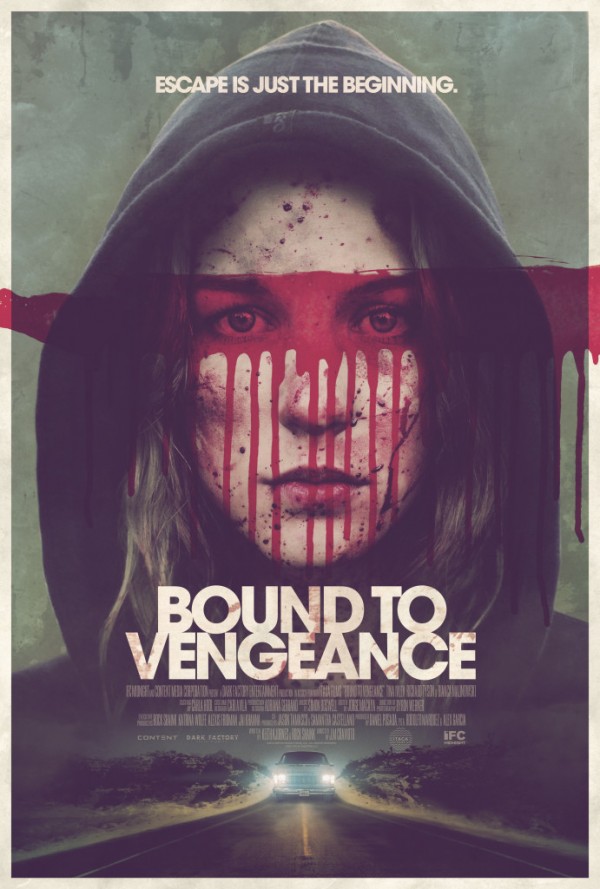
“Bound to Vengeance” is the definition of an indie thriller. In all honesty the movie asks for you to suspend your disbelief from the beginning to the end and there are a few predictable plot points. However, the style, minor twists, and willingness to play with the medium makes it bearable to watch as an average viewer and inspiring for any up and coming indie filmmaker.
Eve (Tina Ivlev) has been held captive in the highly secured basement of a sexual predator named Phil (Richard Tyson). We don’t know how long she’s been there, but the film picks up moments before her escape. Eve is smart, and it seems she’s thought through how to subdue her captor but it’s apparent that she doesn’t know where she is as she exits the house at dusk. With the keys to the only vehicle outside missing, she reenters the place that she knows.
As she rummages through the house, she comes across polaroids of other young girls with numbers by them- including her own. Eve creates a makeshift dog pole catcher with a shower rod and telephone line and uses it to keep Phil at bay as they begin an overnight journey to free the rest of the girls from the polaroids. Of course, this is where the movie derails logically. Why doesn’t she just drive off and call the police? What if Phil has a trap ready for her at another house? If you can swerve around those major plot holes, and accept the movie for what it is, you will be drawn in to Eve’s journey.
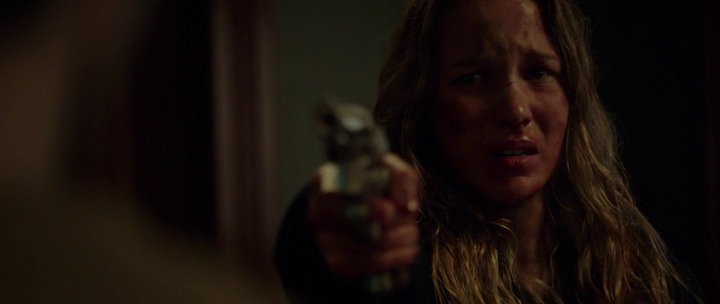
With each house she visits and girl she interacts with, Eve learns something different. There’s no doubt that there’s something about Eve that makes her an awesome heroine. With each stop she puts together the pieces of the puzzle of her kidnapping and so many other girls, while getting some revenge along the way.
Ivlev takes the weight of the movie and carries it in a worthy manner as the lead. She plays Eve with enough gravity to be feared and nuance to be believable. Based on his work in this film, I’m curious to see director Jose Manuel Craviato’s native language films. Craviato plays with the medium in a way that big budget movies rarely do. In one scene, Eve searches for the end of a land line phone, tugging on the chord. With each tug, the camera moves, until it falls to the floor as Eve rushes over to it. This small moment in the film is one of many that shows Craviato’s skill regardless of the script. The cinematography by Byron Werner is also worth a mention as he paints with reds and greens throughout the film, helping to support the repulsive nature of sex trafficking.
While it showed potential for being a revenge thriller with a great female lead, it falls short of the mark. “Bound to Vengeance” is a good choice for Netflix or Redbox.
Rating: C-
Our City Festival '15: "Unsettled" Review
If your style of documentaries are the ones that make you hold your breath as you learn new information, “Unsettled” is a terrific short for you. With the cost of living in Washington, DC increasing, the number of homeless and financially stretched families ticks up too. The film, created by the 2014 Institute for Documentary Filmmaking at George Washington University, puts a face with the numbers and you’re likely to remember them long after the credits roll.
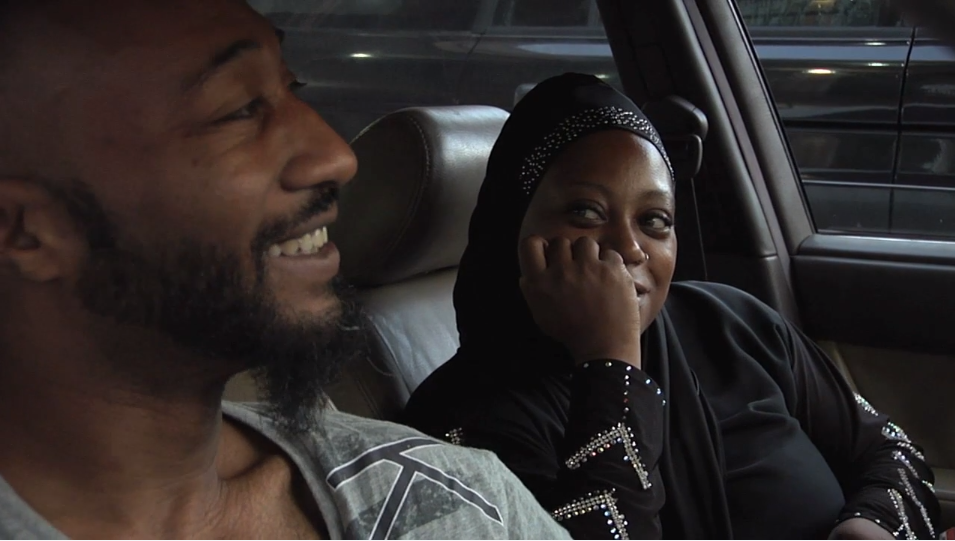
The opening frame of the doc is on a broken rearview mirror, perhaps symbolic of a broken past. The voice of Ken Early is heard as he says “You know they always say the first year of your marriage is the toughest. I don’t think it can get no tougher than this!” Ken laughs between and after his statements as his wife, Naila, looks at him with a smirk of agreement. Ken’s laughter doesn’t come from a place of fun, but of pain. As he goes on to explain that the car they are sitting in was their home for four months. The rawness of the opening scene sets the tone for the rest of the film.

The doc runs a parallel story of Nkechi Feaster, a hard working woman whose past lay offs (three in four years) have kept her looking for financial peace and stability. She has been homeless before, and the possibility of once again being homeless is real as the job she is currently working is coming to an end. Nkechi explains that the American Dream has eluded her even though she did everything the formula said she should by getting good grades in school and getting a job.
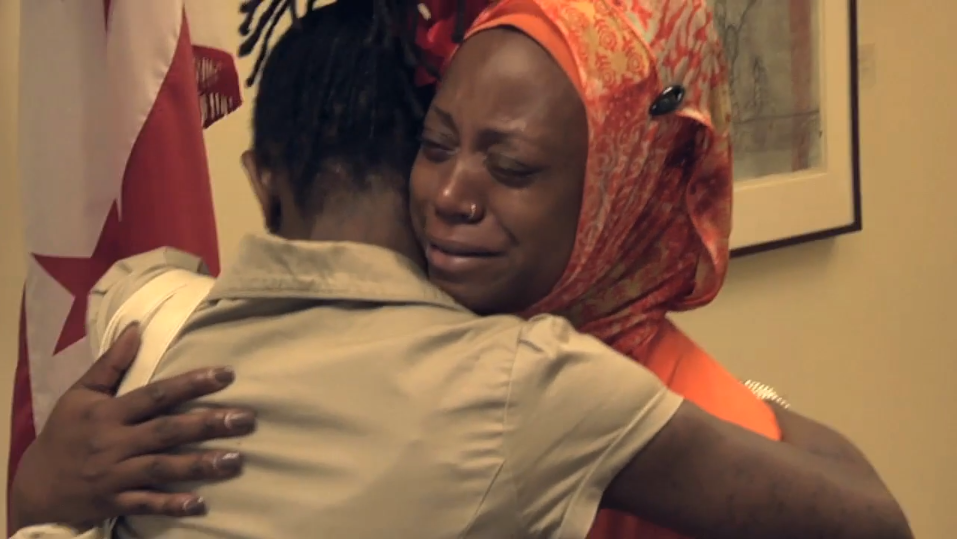
As the two women try to raise awareness of the plight of DC’s homeless, the toll of the struggle becomes evident in a couple heart-wrenching scenes. While the film doesn’t have a call to action at the end, it’s guaranteed to touch anyone who watches it, and hopefully spur someone to get involved. “Unsettled” plays saturday June 6th during the OUR SOUL film screening at Geothe Institut.
Our City Festival '15: "Out of the Basement"

“Out of the Basement” is the indie film that you want to stumble upon at a film festival. Directed by Natalie Avery and Kyle Joseph Centers, the film on the surface is an American Dream, underdog story. In reality, it’s a well constructed story about family bonds and how love can push you to accomplish your dreams or help see others accomplish their own.
We’re introduced to Greg Newby, a DC native and amateur boxer who wants to go pro. He works at his grandfather’s corner store while training. His goal is to use boxing to help himself become financially stable and perhaps financially independent in order to take care of his daughter. As we get to know Greg and see him hard at work, we also learn about his past and how it affects his present.

The key to the film is the relationship between the directors and Greg’s family. It’s obvious that the family trusted the directors, and therefore were honest and open with their lives. Greg’s father talks about his struggle to raise Greg. Greg’s grandmother talks about the fact that someone has always been in his corner, and how she thinks that affects his work ethic. It’s the honest moments in this short film that make it intimate and engaging. The construction of the short doc is smooth, seamless, and welcomes you in to the lives of the tight knit family with pro boxing dreams.
If you’re looking for an entertaining, character driven short that packs a punch than check out “Out of the Basement”. The film plays during the OUR HEART film screening at the Our City Festival this Saturday, June 7th at the Goethe Institut.
GI Film Festival '15: "The Forgotten Angel of Bastogne" Review
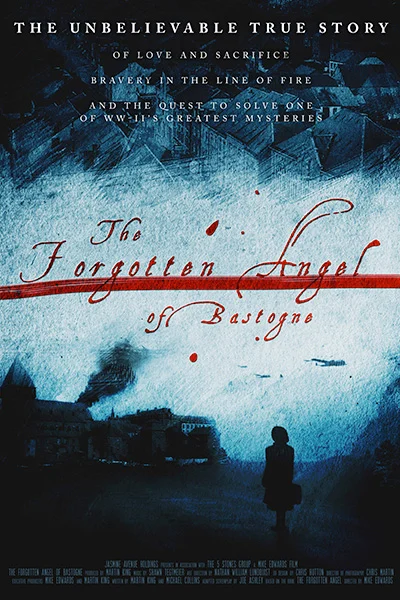
As the saying goes, “history is written by the victors”. Director Michael Edwards’ “The Forgotten Angel of Bastogne” dares to revise the history of Bastogne during World War II’s Battle of the Bulge by highlighting the heroic, herculean efforts performed by a black nurse amidst a racist era. After decades without praise, this documentary gives honor to a very deserving, courageous figure in history.
The film tells the story of Augusta Chiwy, a young nurse born of Congolese and Belgian descent, who with one trip home for Christmas had her life changed forever. In December of 1944, Augusta’s father asked her to come home to Bastogne for the holiday. She made a long trek from Louvain, Belgium to Bastogne. What should have been a few hours turned into an almost day long trip due to the Nazis pushing forward in what’s now known as the Battle of the Bulge.
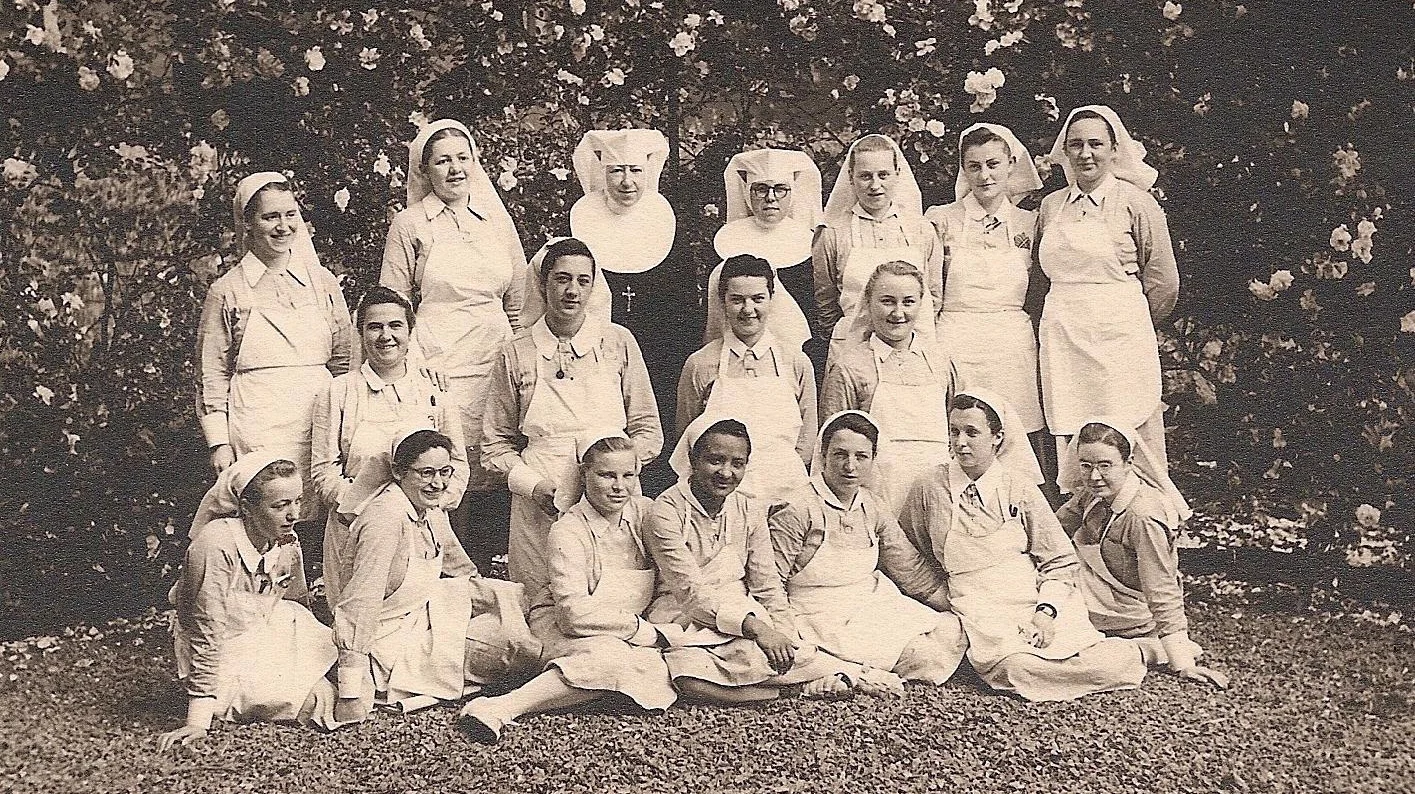
Photo Courtesy of GI Film Festival.
After arriving in Bastogne, swarms of wounded and dying American soldiers poured in to the local aid station. Augusta was asked to help Dr. John Prior at the station, which turned into a triage facility overnight. She worked tirelessly side by side with Prior to save lives in some of the most gruesome scenes imaginable. The pair had to use crude, makeshift surgical instruments, and make due with a lack of supplies. While there, she also worked alongside nurse Renee Lemaire, who has been regarded as the “Angel of Bastogne” since she was the only documented nurse at the aid station due to her race.

Photo Courtesy of GI Film Festival.
The documentary takes nothing away from Lemaire, who deserves the title as history shows, but brings evidence to the forefront that Augusta deserves as much credit for the efforts she made during those brutal days. Perhaps Augusta’s story would still be rumored if not for Martin King, a military historian and authority on the Battle of the Bulge, who set out to find the truth of Augusta’s story. The film presents us with a parallel story of the historical event and the present hunt for the truth by Martin.

Photo courtesy of GI Film Festival.
For those who love history, and those that don’t, what makes this documentary worth seeing is how it brings history to life. Historical photos are displayed throughout the documentary but are infused with moving graphics and sound effects to help viewers be immersed in the moment. Nuanced touches, like light coming through a window of one of its still illustrations, make small details visually stimulating and engaging. The combination of clear historical storytelling and a present day mystery hunt makes for a riveting documentary.
While the documentary presents us with an abundance of history at times, it does a good job of keeping it organized and digestible for the average person. Augusta Chiwy took a stand to save lives regardless of the dangers around her, soldiers who didn’t want her help based on her skin color, and never retreated because it was the right thing to do. It’s that type of character that makes the story worth telling and the documentary worth watching. So many stories of heroism by minorities have been lost to history due to prejudice. This documentary and Martin King’s fight to tell her story, puts Augusta Chiwy in the annals of history where she belongs!
Rating: B+
Check out my interview with director Michael Edwards below!
Here's the trailer for the film:
"Maggie" Review: Almost but Not Quite
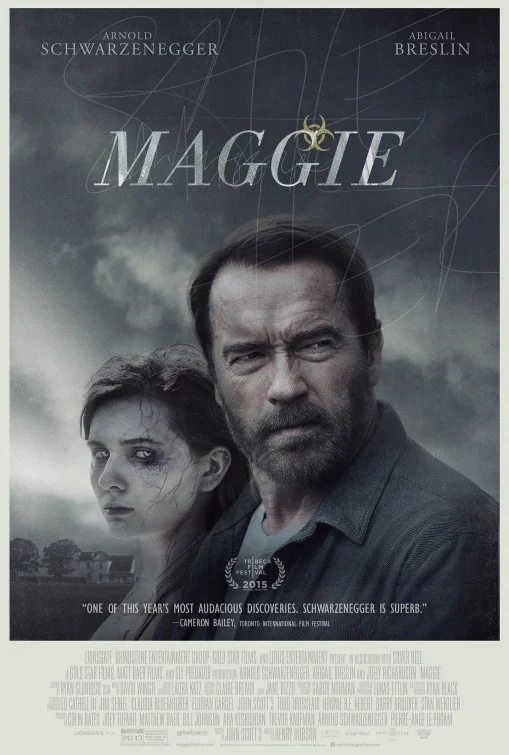
When your child is sick you feel helpless, but when your child is dying a part of you is too. Boiled down, that’s what “Maggie” is, or should be about. If director Henry Hobson and writer John Scott III focused on that phrase, then the film wouldn’t have been an average tale with a small twist on the zombie genre. It could possibly have been a movie that people would be talking about in early 2016!
There’s nothing more powerful than a parent’s love for their child. Wade (Arnold Schwarzenegger), a small town farmer, has spent weeks out in the zombie-ravaged city searching for his daughter Maggie (Abigail Breslin). He brings her back home after finding her in a hospital with an oozing zombie bite.
With limited time until she “turns”, Wade must decide what he will do once she turns into a zombie and Maggie has to deal with her “death sentence”. Most bite victims in town are taken away during the last couple of weeks before they turn or are killed, and the local police make sure Wade knows Maggie is no special case. Maggie’s step mom, Caroline (Joely Richardson) is equally skeptical of Wade’s decision but supports it with both eyes open.
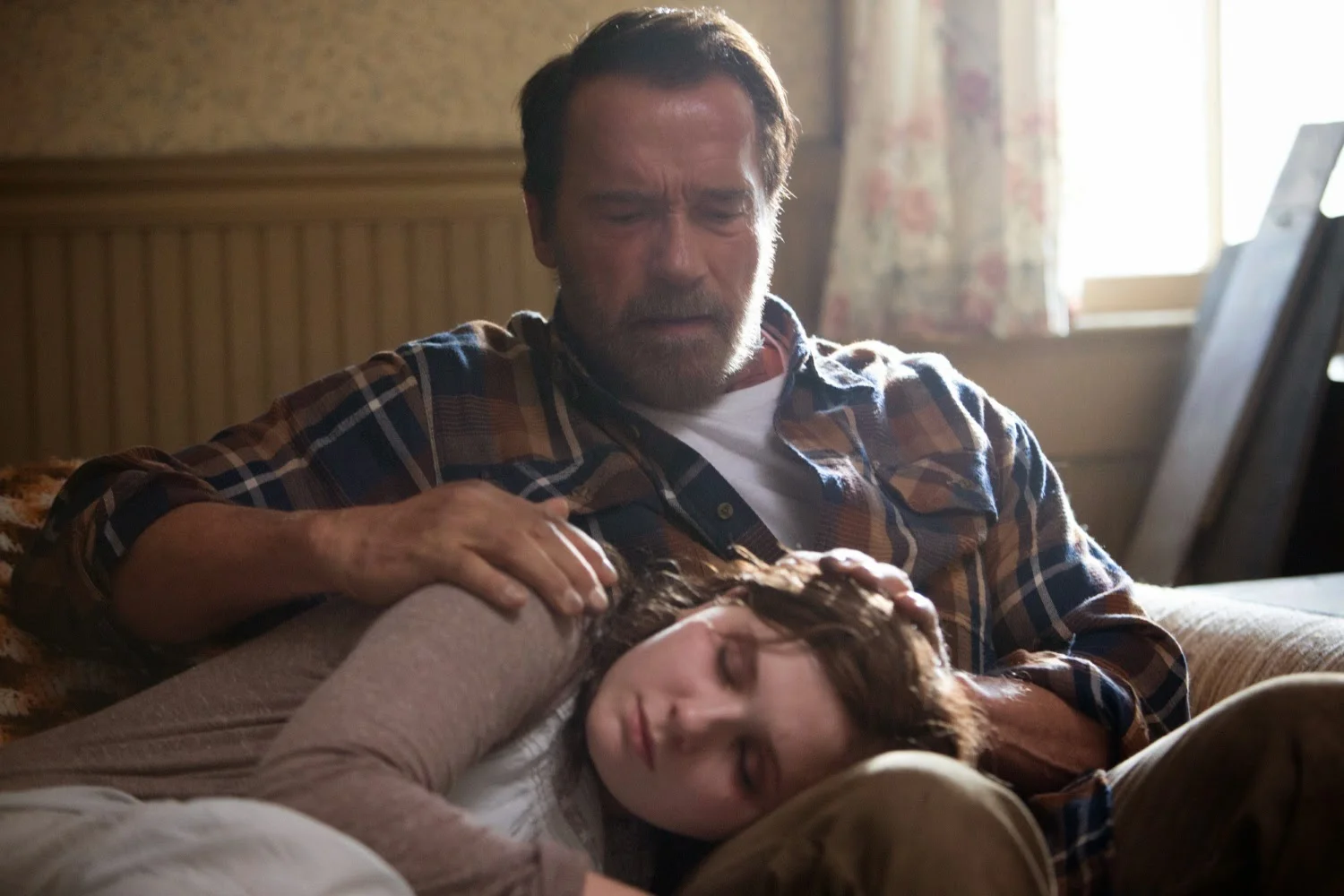
The anticipation of the end and the journey to get there has all the makings of a suspenseful, slow burn drama. Unfortunately, it derails a third of the way into the film. As Maggie deals with the loneliness of exile, she reaches out to Trent (Bryce Romero) an old flame further along in the turn then she is. Rather than keeping the drama to an intimate family problem, we’re forced to watch Maggie and her teen friends that we don’t care about deal with the turn.
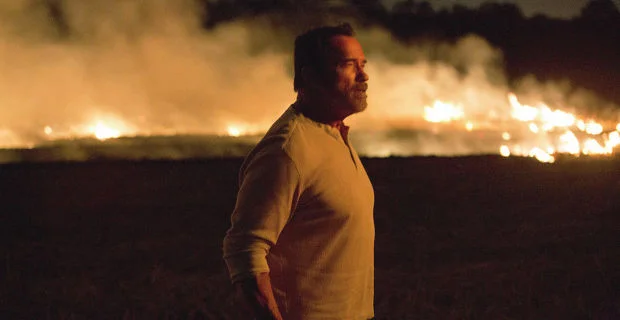
You can tell that Arnold dug deep for this performance, and while his dialogue and acting is still stiff at times, he certainly displays his internal conflict in his eyes. Breslin, on the other hand, seems to be swallowed by the character and disconnected from emotional gravity of the situation, which results in an awkward performance. Sure, she’s a teenager and teenager’s emotions are all over the place, but even a teenager can pinpoint and articulate their feelings verbally and nonverbally.
“Maggie” has moments of emotional significance that if explored further would have made it a better film. While on the surface it’s about a parent’s love, when the film plays out, it doesn’t quite tap into that power. Instead, it is an interesting concept that missed the mark.
Rating: C-
Tribeca Film Festival '15: "Stranded in Canton" Review
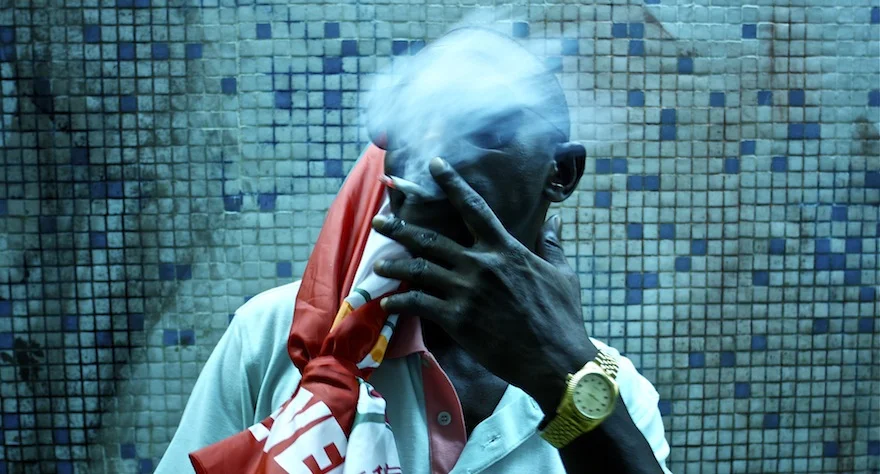
Photo Courtesy of Tribeca Film Festival
Independent cinema allows us to be presented with characters who are typically underrepresented on the big screen. With “Stranded in Canton”, writer/director Mans Mansson gives us an interesting character study in Lebrun (Isibango Iko Lebrun), a Congolese farmer whose dreams for a better life both propel him forward and blind him simultaneously.
Lebrun is a wanna be entrepreneur who believes every excuse that comes out of his mouth and hopes you will too. In fact, he’s counting on it. His most recent endeavor finds him stranded in China after ordering a large amount of t-shirts for the election back home in the Democratic Republic of Congo. Unfortunately, he receives them after the election has passed and with boxes full of shirts that say vote for a president who can not run for office again, Lebrun has to figure out a plan B.
Lebrun doesn’t have much time to figure things out. Wassim (Wassim Hasbini), an overweight storage space owner who rides a moped to travel a few yards away, wants the money he’s owed for holding the t-shirts in storage. The Chinese want the money for making the t-shirts, and Lebrun makes calls to an elder back home who he’s seemed to promise a watch and an engine at least. As the movie continues it becomes more apparent that Lebrun doesn’t really have a plan, and may not have had one when he ordered his shirts, outside of selling them for a profit.
Sylvie (Sylvie N’Dya) is a fellow African living in China, and the one person who takes the time to listen to Lebrun and give him advice. She has her own shop and the wisdom that comes along with it. Yet when she tells Lebrun the truth about his shirts (possible failure), he continues to push forward off of his half-baked idea to make money with an eerie sense of calm and a desire to prove his worth as a businessman.
Mansson has complete control of the direction of the film. He uses pacing and extreme close ups as tools, forcing us to focus on what he wants. In a film in which so many different languages are spoken, he understands that sometimes the eyes convey what the lips are saying. While the film is subtitled, its visuals speak volumes. He let’s moments within the film play out to the point of exhaustion in a way that feels more like a documentary than a fictional narrative.
While we’re left with a real look at what an unskilled businessman looks like, the film spends too much time in the same position. There are not many new developments in plot, nor a major conflict. Everyone wants their money, but there’s not a real threat to Lebrun to give it to them. While the film does raise questions of politics and what success is, it struggles to bring it all together. Like Lebrun, “Stranded in Canton” is a great idea running off fumes rather than cinematic fuel.
Rating: C
Now playing: https://tribecafilm.com/filmguide/stranded-in-canton-2015
Tribeca Film Festival '15: "Cafe Glass" Review

As the internet and social media continues to expand, writer/director Wen Ren paints a future where online dating is the social norm. People walk around with “wearables” (technology that you wear like glasses) that give you automatic access to the internet. Users are alerted when another user is checking them out, and they can reject their virtual advances on the spot. The film’s CG work does the heavy lifting to make this world a reality as it’s main character, Zayn (Devin Goodsell), visits the local cafe to sit with his friends.
As the cafe loses internet connection, the entire patronage is in an uproar as they have to come face to face with one another with no online connection. Zayn is then forced to make a decision as to whether to take his most recent encounter offline. While “Cafe Glass” may be a comedy, it stirs up serious questions for what seems like a not too distant future. As we exchange personal connections for virtual ones, what does that mean for future generations? Are social skills morphing or declining? “Cafe Glass” is sure to give you a couple laughs, but it will equally give you something to chew on.
Now playing: https://tribecafilm.com/filmguide/cafe-glass-2015
DCIFF '15: "House of Manson" Review
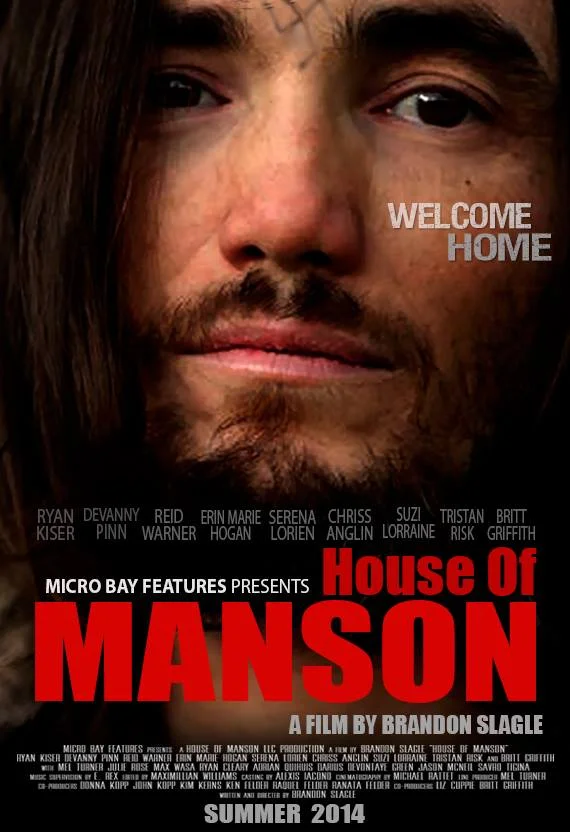
Writer/director Brandon Slagle’s “House of Manson” chronicles the life of Charles Manson (Ryan Kiser) leading up to the infamous Tate and LaBianca murders.The film doesn’t attempt to glorify or villianize Manson. Instead, it’s a by the books account of one of America’s most talked about killers.
The film moves swiftly through Manson’s early life. It focuses more on his time as a wandering musician, eventually leading up to starting the Manson Family. There is a lot of emphasis on the use of sex and drugs as a way to seduce, particularly the women in the family. Overall, the charismatic “star power” of Manson (the ability to influence others to kill at the time) is lost in the film, and his influence seems to stem more from the drugs, but perhaps that’s the point.
The cinematography throughout the film is incredible. It captures the look and feel of the late 60’s shooting many scenes at golden hour to create a dream like look that’s close to the drug induced haze its characters are in. It also uses chiaroscuro (Italian word for strong contrast between light and dark) to its advantage. Once the violence gets going in the movie, the black is crushed and there is a steep drop off from light to dark in all of the scenes. The skillful implementation of this technique casts ominous shadows on the actors in all the right places, supplementing the horrific actions they carry out.
The biggest issue with “House of Manson” is that its actors play crazy, and do more acting when they aren’t speaking. The cast of characters have an uncanny likeness to their real live counterparts. However, most of the lines are delivered based on what should be said next rather than a reaction and response to what was said. There are glimpses of three dimensional human beings in Davanny Pinn as Susan Atkins, Reid Warner as Tex Watson, and Kiser’s performance, but most moments feel like caricaturizations.
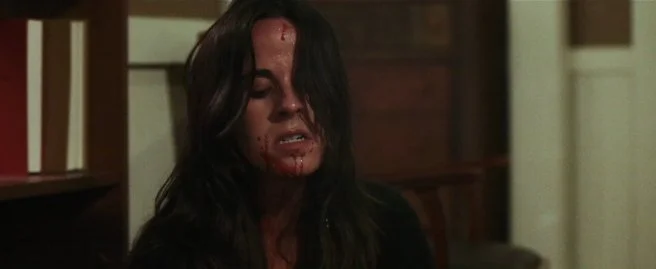
Slagle’s unbiased approach is helpful in swallowing the extreme violence the last thirty minutes of the film delves into. Thankfully, he uses more of a Hitchcockian technique by showing less, and using audio to clue us into what’s happening. Overall the film is a bit sterile for the subject matter. “House of Manson” has its East Coast premiere tonight at 9:20pm at the DC Independent Film Festival.
Rating: C
DCIFF '15: "Southeast 67" Review

“Southeast 67” is a documentary that speaks to the power of education, altruism, hard work and love. Using a mixture of archival footage and photos, and shooting presently with some of the first I Have A Dream program students, it tackles the age old question of who wins: nature or nurture? The documentary refreshingly dares to answer “life isn’t that black and white.”
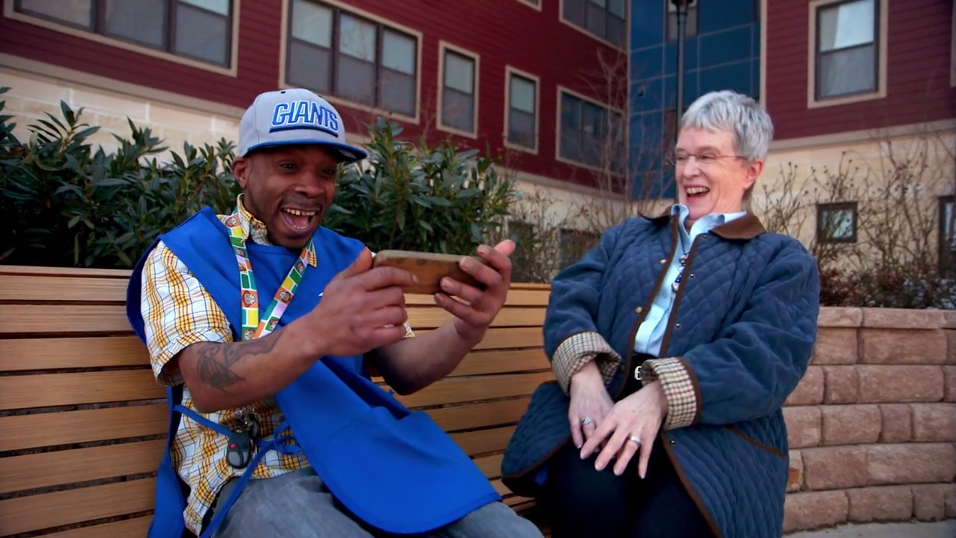
In the 1980s, Washington D.C. was known as the “Murder Capital”. Stewart Bainum, a businessman in the area, promised college scholarships to 67 rising seventh graders through the I Have A Dream program. Out of the 67 Dreamers, 72% graduated from high school and 6 went on to get degrees. Writer/director Betsy Cox catches up with some of the Dreamers and their teachers, Phyllis Rumbarger and Steve Bumbaugh, and captures a family reunion on screen amongst the group. It’s clear that the time in the program was a special moment in everyone’s life.
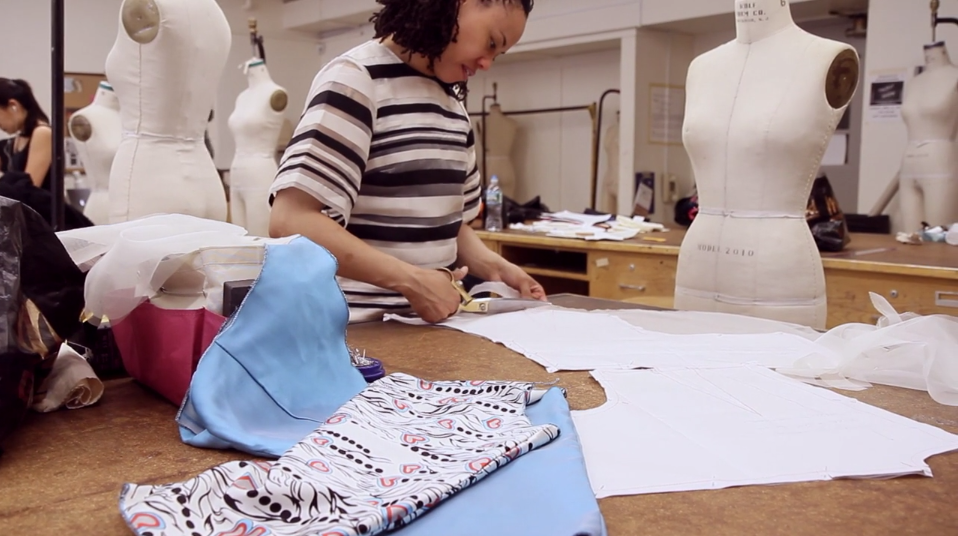
Each personal story presented is diverse. No two Dreamers are the same. The entrancing part of being able to catch up with the Dreamers twenty years later, is that you can formulate an answer to whether the opportunity to get out of a drug and violence filled environment to pursue a better education was enough to put them on the path to success. For some of the Dreamers that appear in the documentary, the opportunity came at a price that we may not instantly think of. Most of them were worried more about their mother being in an abusive relationship, possibly overdosing on drugs in their absence, or where they would get money to live while being away. These haunting thoughts kept some of them paralyzed to move forward, while others were able to take full advantage of the opportunity. Yet, the outcomes twenty years later are equally positive in their own way.
One of the most intriguing things about the documentary is seeing the generational impact of decisions. Sadly, many of the Dreamers were fighting just to make it into the middle class, but the opportunity to have hope for a different future had a lasting impact that has touched their children's lives. The film could have easily slipped into the sensationalism of one white man giving 67 underprivileged black kids a helping hand. Instead, it focuses on love, which sees no color, and permeates each frame from the inside out with undeniable results. “Southeast 67” plays at the DC Independent Film Festival on Friday, February 27th at 7:30PM.
Rating: B
DCIFF '15: "Blood, Sweat, and Beer" Review
It would be easy to dismiss a documentary about beer, or think that it would be best displayed in the background of a fraternity party. While “Blood, Sweat, and Beer” does make you want to grab a cold one, directors Chip Hiden and Alexis Irvin have crafted a film that’s more about the American dream, dedication to a burgeoning trade, and following your passion no matter the cost. Whether you’re a beer connoisseur or not, this documentary speaks to everyone on some level.

The film follows two main stories. In Braddock, PA, a trio of 23 year olds start The Brew Gentlemen Beer Company against all odds. Braddock, a run down former steel town, has suffered from years of abandonment and a population decrease. The young men hope that their brewery will be a beacon of hope for the city’s revitalization. While that lofty goal sounds great, the struggle to see the brewery come together finds them working around the clock with little to no income. It’s do or die for them, and the hundreds of thousands of dollars that investors have put in the company has to be paid back.

In Ocean City, Maryland we’re introduced to Danny Robinson. Robinson is a brewer whose business struggles to get sales on the boardwalk on a regular day, but is now in a nasty trademark lawsuit battle. The filmmakers track his story over the course of a year, from the storefront opening to his final court date. Robinson’s underdog story is perhaps the emotional core of the film as he continues to try and run his business with the mammoth suit hovering over him. Yet his resolve to keep pressing forward is what the American workforce is built on.
Towards the end, the film struggles to stay on track. It dips into the realm of women in the craft brewing industry. While it’s a worthy topic to explore, it comes out of no where and is gone just as quickly as it appears. While it certainly doesn’t derail the film, it would have been great to learn more and have it weaved throughout the film or not touched at all.
Coming off of their debut documentary, “The Dream Share Project”, Hiden and Irvin have managed to infuse their passion for people following their dreams with their love for craft beers in their latest project. Ultimately, “Blood, Sweat, and Beer” is an informative documentary about craft brewing through the lens of brewers trying to earn a living. “Blood, Sweat, and Beer” plays at the DC Independent Film Festival March 1st at 2:40PM.
Rating: B-
"Birdman or (The Unexpected Virtue of Ignorance)" Review
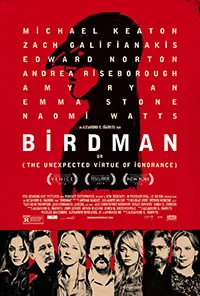
“Birdman or (The Unexpected Virtue of Ignorance)” is a cinematic experience. It’s one of the films that going into knowing very little about it, makes the viewing that much better. From the opening frame you’ll be swept up in its direction.
Michael Keaton is Riggan, once a big movie star of a franchise entitled Birdman, he is now directing and starring in an adaptation he’s written of a Raymond Carver story. He’s doing if for glory and redemption. He wants the court of public opinion to be swayed back in his favor. He wants to mend the relationship with his fresh out of rehab daughter, Sam (Emma Stone). Most of all, he wants to prove to himself that he still has what it takes.
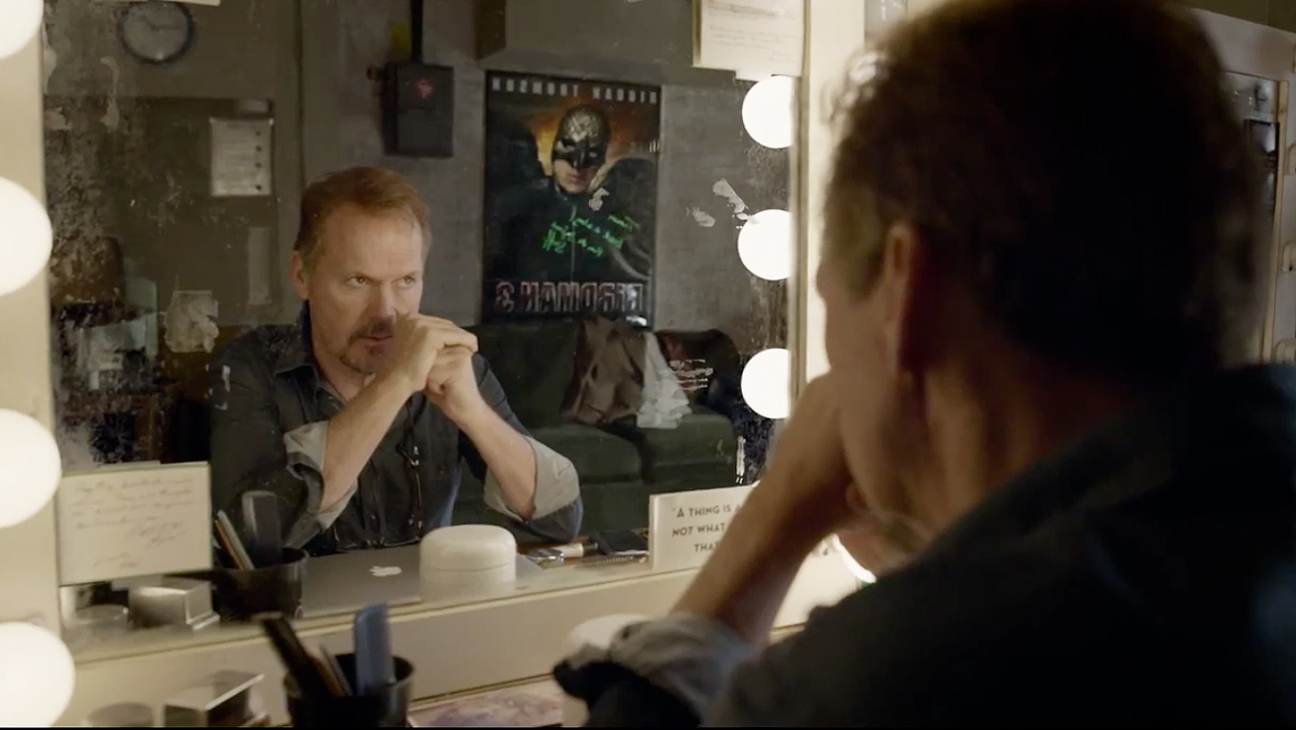
Throughout the film, Riggan is haunted by the voice of Birdman. His younger self continues to taunt him by telling him about how great he could, should or would be if. It’s the voice that we all have heard in our own heads at some point, but the difference is our voices don’t give us magical powers. It’s not even clear if the “powers” Riggan has are real in this cinematic world or not, but that’s part of the fun of the film.
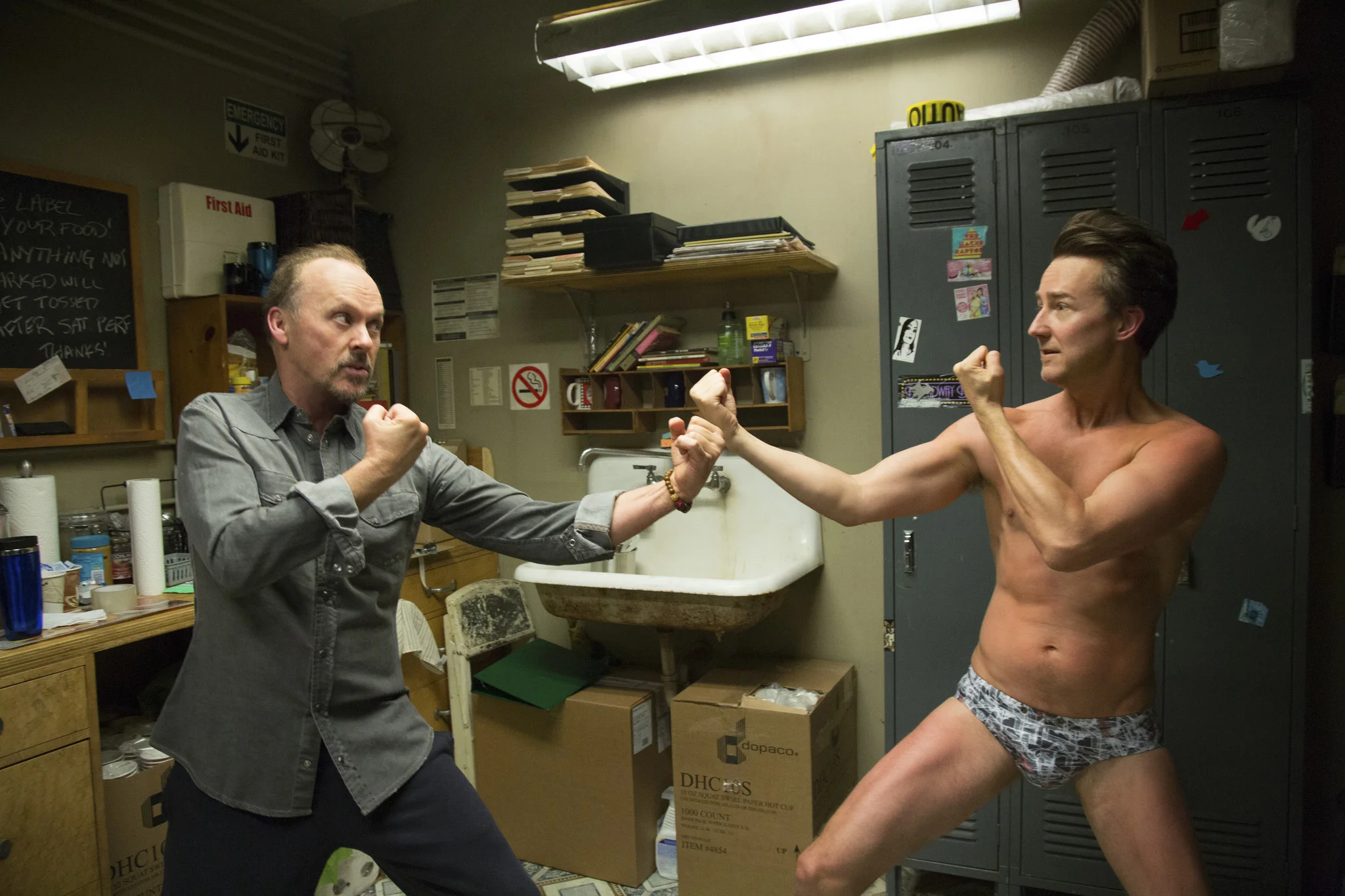
It doesn’t help that Mike Shiner (Edward Norton), the darling of Broadway, is now slowly making himself the star of Riggan’s play by inserting his method acting into the show. As the film moves forward, Riggan fights against himself and his young co-star for the praise of Tabitha (Lindsay Duncan). With one stroke of the pen, Tabitha’s critique can launch Riggan’s play to Broadway heaven or hell.
Co-writer/director Alejandro Inarritu and cinematographer Emmanuel Lubezki deserve more credit for the brilliance of this film. Inarritu’s vision to use single takes with invisible cuts makes the film flow seamlessly and forces the actors to deliver strong, in the moment performances. The occasional time jump that happens so discretely your mind has to catch up makes the film even more magical. It’s engaging and exciting to watch, and that kind of filmmaking doesn’t just happen. It’s a great collaboration between the visionary and the painter who ensures the picture will support that vision.
The intensity and mundaneness of life behind the curtain on Broadway is captured with just the right amount of ebb and flow pacing. The buzz surrounding Keaton’s performance is warranted as he quarterbacks the ensemble team. Each actor brings it in the film.
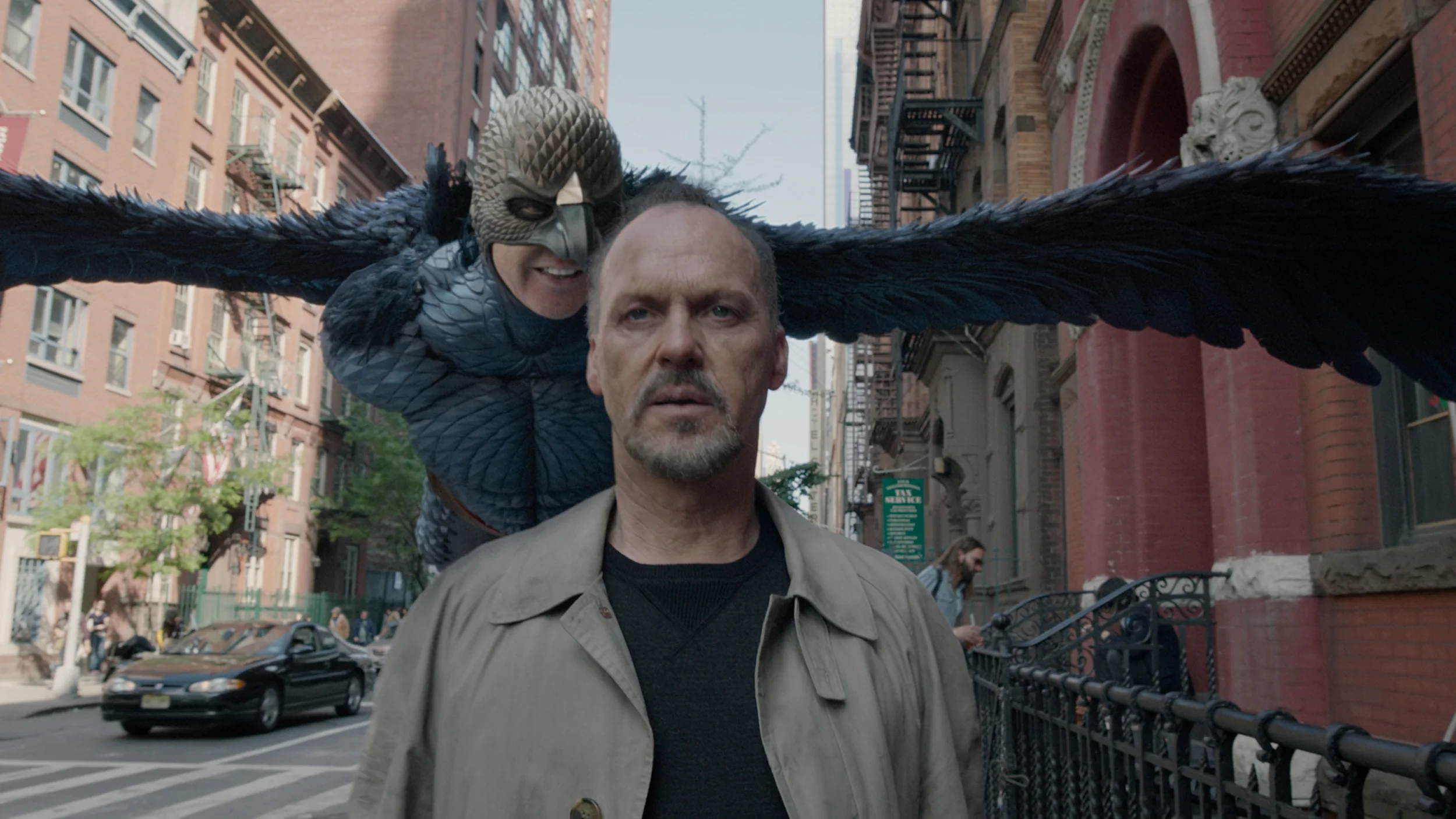
Overall, the “Birdman” is a bit trippy and sometimes you don't know what's real and what's not, but it's done in such an artistically inspired way that works for the objective of the film. Which on the surface is about a one time celebrity's internal struggle and fight to make himself relevant again, but ultimately it's about our desire/need as humans to be loved and remembered.
Rating: A
"Whiplash" Review
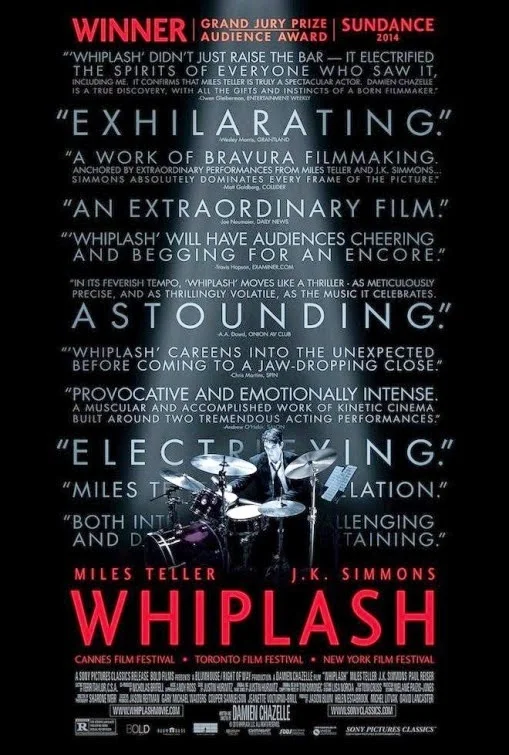
“Whiplash” is “Rocky” with band instruments! No, really! It has an underdog with a dream, bloody training montages, and the coach that’s trying to push him to greatness. It’s an utterly mesmerizing film about the lengths some people will go and subject themselves to in order to achieve perfection!
You know that goofy smirk you make, when a character you’re rooting for does well? You’re guaranteed to make more than a few of those throughout the film. Never have you rooted for a protagonist so quickly than with freshman Andrew (Miles Teller). From the opening frame he’s in a room by himself practicing the drums, laboring away at his passion. We’ve all been in his shoes as the nervous, new kid on the block. He’s awkwardly trying to figure his way through the fictional Schaefer Conservatory. He’s doing what he loves most at the number one school in the country.
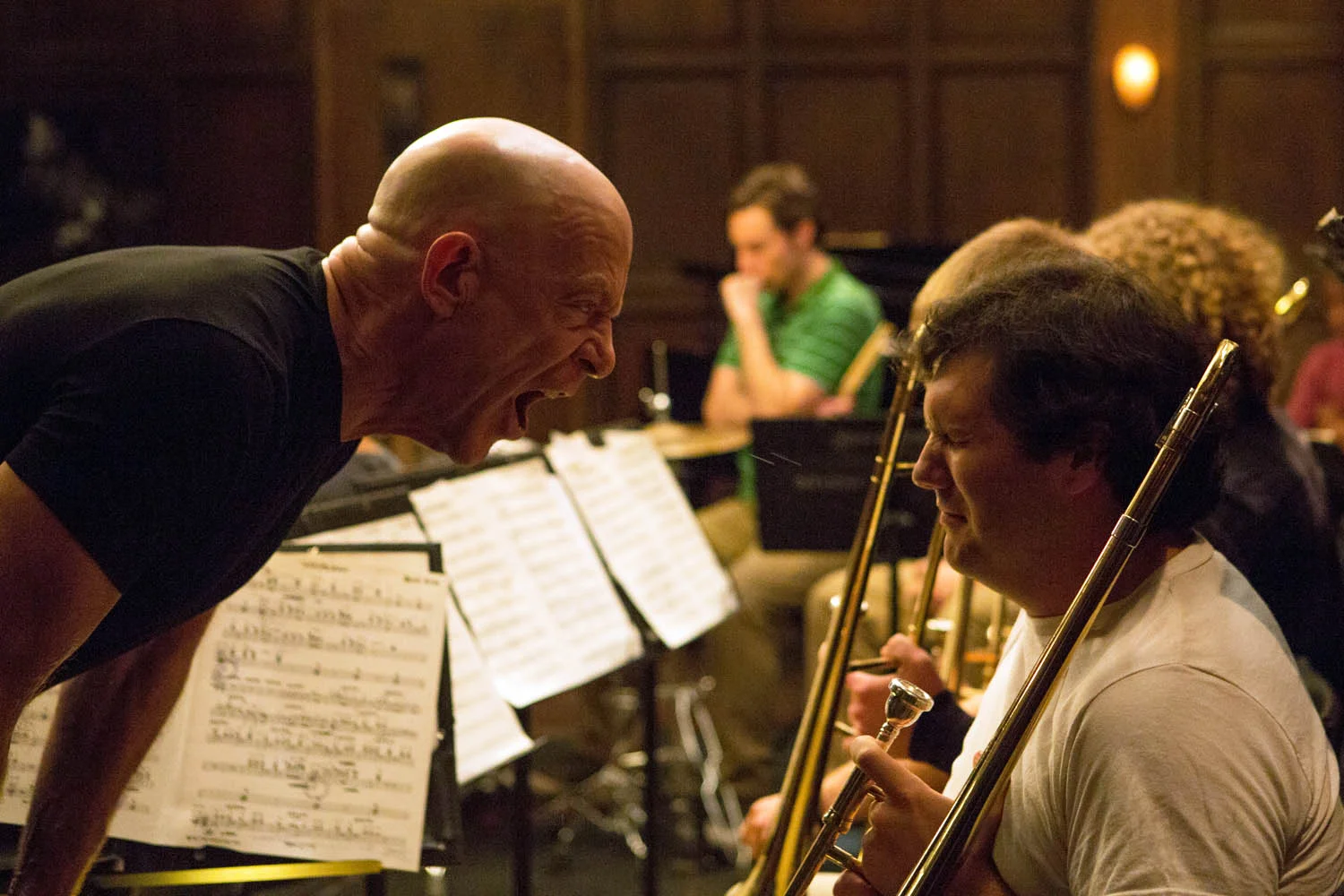
J.K. Simmons is an atmosphere changer as Fletcher, the school’s core band maestro. Fletcher commandeers respect, and has a no-nonsense attitude when it comes to his band. He brings Andrew up from “JV” to play with the big boys in the core after hearing him practicing alone. As Andrew slowly assimilates into the core, he witnesses and becomes the subject of Fletcher’s abusive push to make his band great.
The humiliation at the hands of his director drives Andrew to practice harder. As he becomes more laser locked on achieving greatness, he also destroys relationships and sometimes himself in the process. Regardless, Andrew’s arch over the course of the film is something to see as you watch the underdog rise!
This film is an excellent example of when a writer also being the director can create something truly amazing due to his or her deep understanding of the film they are making. Damien Chazelle absolutely knocked this film out of the park in pacing, tone, and direction! Simmons range throughout the film is undoubtedly incredible. He walks the line of genius and psychopath with ease as he pushes his students in dehumanizing verbal rants and the occasional hurling of instruments. Miles Teller turns in a terrific performance as a young student willing to pay the cost to be the best. It’s obvious that Teller gave all of himself to the role as he physically sweats and bleeds over his drum kit. The chemistry between the two is perfect as they have a battle of will.
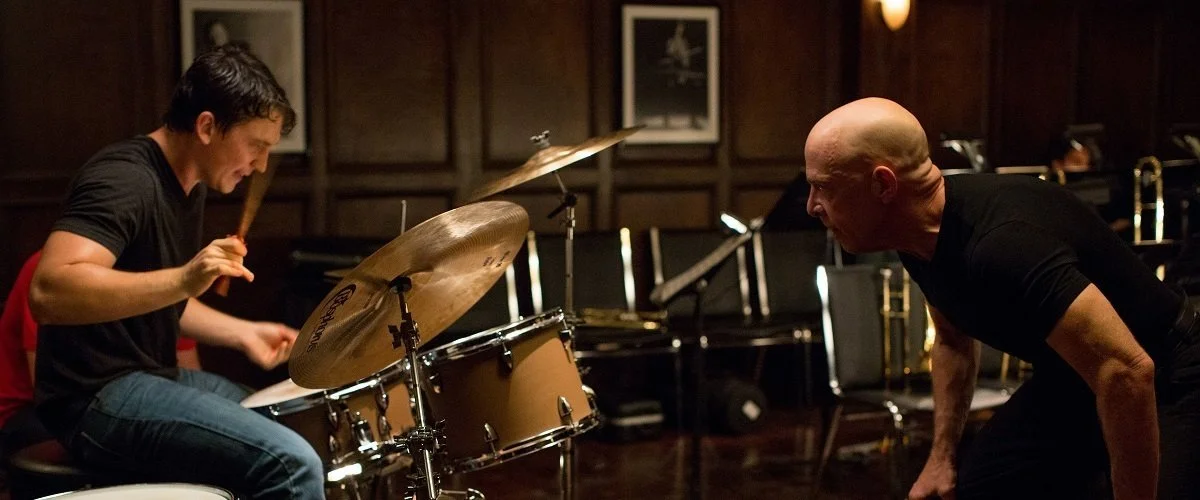
“Whiplash” is definitely one of the best films of the year! The final scene, much like a “Rocky” movie, is one of the best emotional showdowns without the use of words or fists-just music-that I’ve seen in film. It’s an all around hypnotic film that will have you playing to the beat of its drum!
Rating: A+
"Two Days, One Night" Review
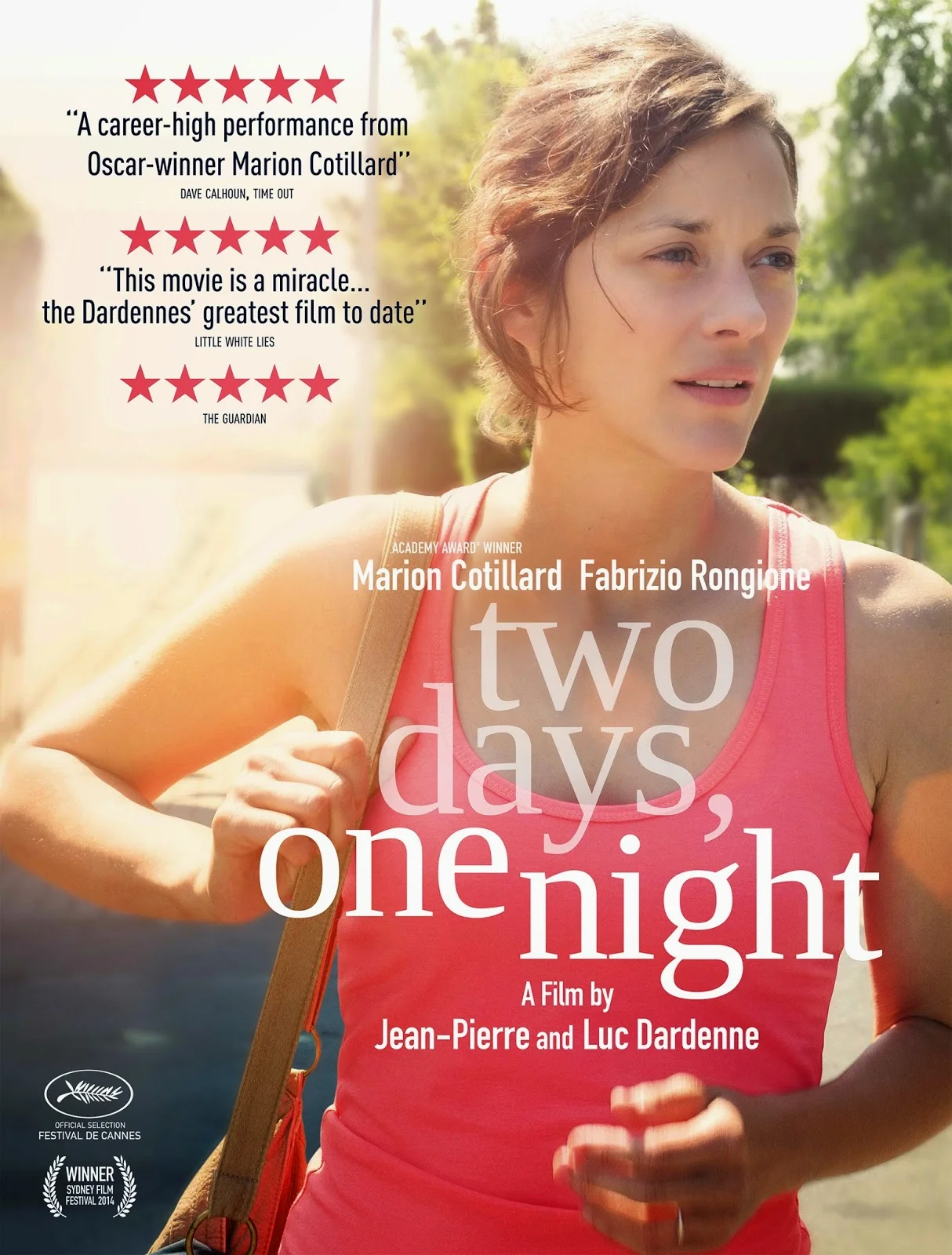
If there is one foreign film you should see this year it’s “Two Days, One Night” from the Dardenne brothers. In short, one woman fights to keep her job over the course of a weekend. The film’s simple premise however, provides the groundwork for a universal human story.
Sandra (Marion Cotillard) is a young Belgian mother who just received the news that her employer is going to terminate her position at the local factory while she is out on sick leave. In fact, after taking a vote, her co-workers elected to take a 1,000 euro bonus rather than keeping her in her position. With only two out of sixteen voting in her favor, Sandra has one weekend to convince the majority to vote for her to keep her job in a secret ballot to be held on Monday.
As the weekend moves forward, Sandra, encouraged by her husband Manu (Fabrizio Rongione), slowly starts to visit each one of her co-workers to humbly ask for them to vote for her to keep her job to help her provide for her family. Each person she encounters has a heart-wrenching decision to make. For most, it’s providing for their own families versus supporting her to keep her job.
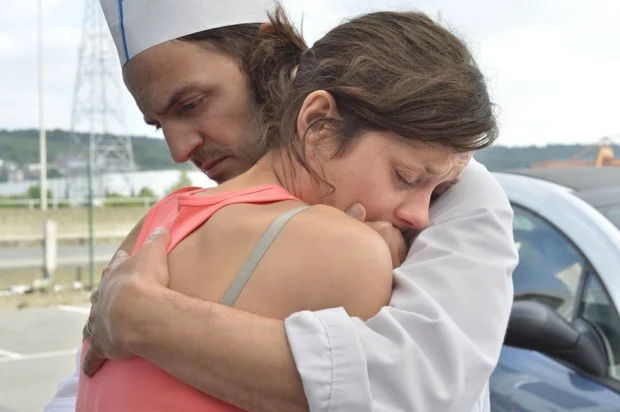
Cotillard is definitely one of the great actresses of our time. There is something magnificent about her performance in portraying the everyday blue collar worker with such grace and honesty. She absolutely vanishes into the role in a film directed by brothers who usually cast unknowns.
The Dardenne brothers’ direction in the film is present throughout. Their use of long takes in which the camera doesn’t cut away from the action, but lingers on long enough to make things feel awkward, captures the beauty of Sandra’s journey. The moments when she lets down her confident mask after putting her heart in her hand and offering it to her co-workers only to be rejected, or sheds tears of joy when a co-worker gives her their backing. Their understanding of the subject and use of the medium to tell the story is powerful.
The film is a suspenseful journey into one woman fighting for the ability to earn a living. It’s a reminder to be grateful for those of us who are employed. Most importantly, it’s a lesson in how to keep your head up and never lose yourself in spite of the circumstances.
Rating: A
"Dior and I": Middleburg Film Festival Review

Director Frederic Tcheng explores a world that most of us have no idea about outside of the label or knock off we wear in “Dior and I”. It’s a film full of moments that are superficial at best. It’s also a beautiful look at what harnessing our passion, talent, and drive can create in our lives and the lives of those around us.
The film documents the struggle of Raf Simons as he becomes the newest Creative Director at House of Dior. It leads up to his first collection showcase that he only has eight weeks to pull off. (Usually the process is allotted four to five months.) Simons is extremely nervous about the process, as anyone would be, and imposes his high expectations on the people working under him.

While Simons is a ball of nervous energy on screen, the heart of the film is the ateliers and workers who tirelessly grind day and night to create the signature collections that so many people love. Dior has a low turnover rate, with many of it’s employees having been their for over twenty years. We’re introduced to many of the key members of the staff. The family environment that Dior himself created is seen and felt throughout the film and most of that is evident in this segment of the film. Yet as parallel stories begin to weave together and become one, we see the common thread of Christian Dior. His impact and vision both haunts and motivates everyone long after his death.
In the days and hours leading up to the collection showcase, the pressure intensifies for Simons and the Dior employees. It’s in this moment that Simons breaks down and we see the human behind the mask. In fact, even during the showcase he bawls uncontrollably, and it’s beautiful! It’s a moment that anyone can relate to. The moment when you’ve put your all in to something and it comes together exquisitely; it’s an amazing feeling no matter who you are or what position you hold.

“Dior and I” is a documentary that allows a glimpse into the world of high fashion. In the wrong hands it would be a reality TV show that us regular folk point fingers and laugh at! Instead, it fights to push past the glitz and glamour to tell a universal tale of creativity at its best!
Rating: B
"Red Army": Middleburg Film Festival '14 Review
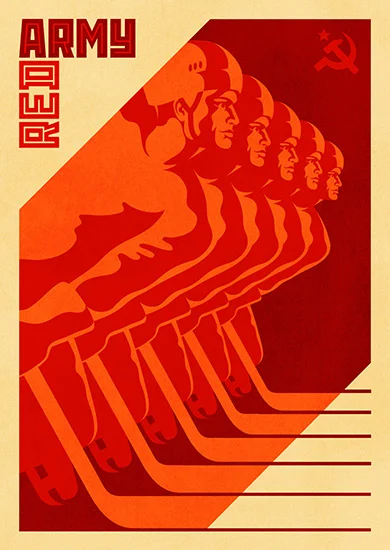
I’m not a sports fan, I’m a movie fanatic. The closest I’ve been to seeing a full game of hockey is “The Mighty Ducks” 1-3. So going in to see “Red Army” at the Middleburg Film Festival I was expecting to be bored by an archival documentary about a specific team in hockey’s past. Instead I was blown away by a fast paced, exciting film. “Red Army” is the perfect blend of sports drama, history lesson, and compelling cinematic storytelling!

The film focuses on the former Soviet Union’s Red Army hockey team. Director Gabriel Polsky brilliantly uses playful humor with the pre-baked dramatic themes of the Cold War, democracy vs. communism, and sports competition. The star of the film is Viacheslav Fetisov, the former captain of the Soviet national team, and he delivers first-hand commentary as we weave through time up to present day. Whether talking about the Red Army’s extreme work ethic and discipline, the thrill of winning Olympic Gold, or pain of failed and lost relationships, Fetisov is the heart and spine of the film. We also hear from other star players of the team, retired KGB officers, sports journalists, and government officials which gives the film a dual feel of a behind the scenes look at the hockey team and communism simultaneously.
Polsky shows his mastery of the medium using all the tools at his fingertips in a symbiotic effort to push the story forward. Lower thirds translate from Russian to English, the titles and awards of Fetisov quickly fill up every inch of the frame around him showing just how talented he was, Russian tunes compliment the visually silly but amazing work out routines of child hockey soldiers! He dollies the camera in to cap off an interview at times throughout the film, making the interviewee and viewer on edge, but many times evoking a priceless reaction from the on camera talent.
“Red Army” ultimately gives us a glimpse at how much can change in one lifetime. Whether it’s the change of thinking/regime from the USSR to Russia’s current state, Fetisov’s personal life from “child soldier” to holding the position of Minister of Sport in Russia for a time, or the sport of hockey itself, the film speaks to our ability as humans to learn, grow and change. Whether you're a sports fan or not, it’s a must see documentary!
Rating: A
Check out the live Q&A after the film:
"Fort Bliss": The Other Side of War
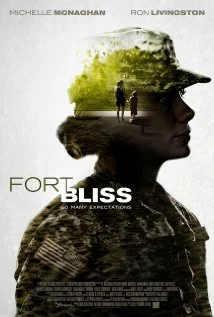
“Fort Bliss” has all the makings of a Lifetime Original Movie in theme. A decorated U.S. Army medic and single mother returns home after touring in Afghanistan to face a troubled relationship with her five year old son. The film however, is far from a Lifetime movie! It’s a character study that civilians probably have never thought about, and the military community knows all too well.
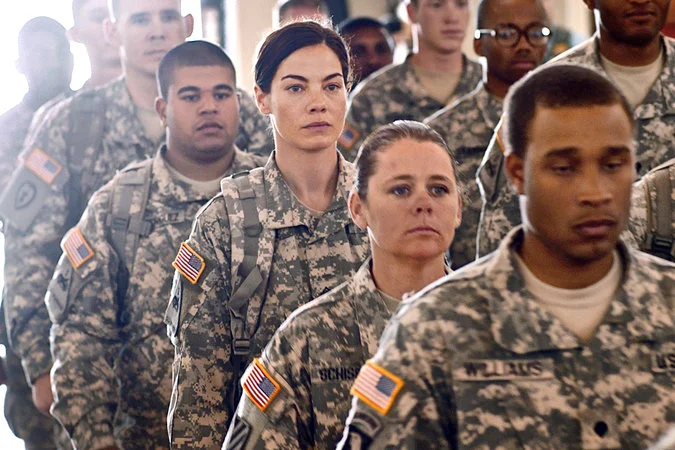
If “The Hurtlocker” spends 90% of it’s time in the war and 10% at home, “Fort Bliss” is just the opposite. In fact, you could say that it picks up where it left off. Maggie Swann (Michelle Monaghan) has been through it. We first meet her on the battlefield where the tough-as-nails medic saves a soldier who has a live explosive device lodged in his stomach. She’s a hero to the core, can hang with the boys, but wouldn’t take credit for anything but doing her job. Upon arriving home in the states she’s greeted by...no one. Her ex-husband Richard (Ron Livingston) meets her outside of the welcome facility to explain that her son doesn’t want to see her after her extended tour has left him with few memories of her.
This is where the real fight of the movie takes place. Swann desires to reconnect with her son Paul (Oakes Fegley) and goes to pick him up to take him home with her, but it’s an uphill battle. He’s been under the tender wing of Richard’s girlfriend Alma (Emmanuelle Chriqui) and doesn’t want to leave. Monaghan does fantastic work in this film, as from the beginning you can read so many thoughts on her face without her saying a word. You can tell she’s decompressing and trying to turn off the battle she just left in Afghanistan, while at the same time trying to fight for the love and connection with her son that they once shared. How do you get there? On the battlefield orders are made and actions take place, but when it pertains to someone’s heart...things aren’t so simple. Every decision Swann makes stems from the tug of war between her professional and personal emotions and ideals.
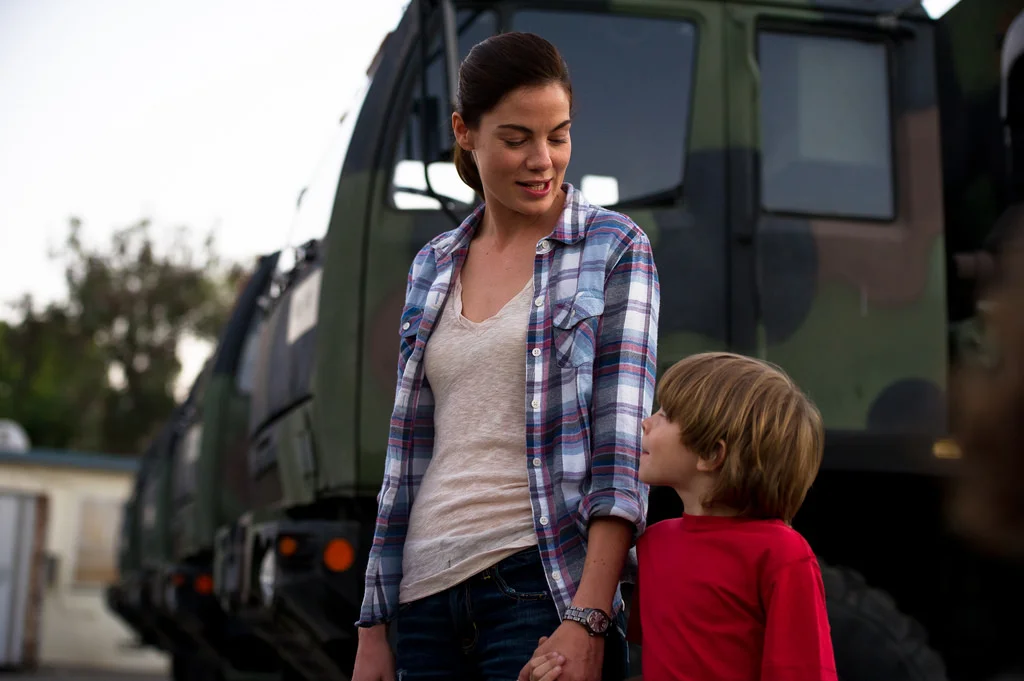
Written and directed by Claudia Myers, the film is a labor of love as Myers poured years of research into it. The balance of character driven drama and action on the battlefield is exciting to watch. It’s Monaghan’s performance that grounds the film in a real, tough, and universal struggle that anyone can relate too. The film opens today in select theaters and everywhere on Video On Demand. Check it out if you want to see a war movie that sheds light on the side of war we tend to forget, but should have a healthy respect and appreciation for!
Rating: B+
Check out my interviews with some of the stars of the film at the GI Film Fest earlier this summer!